
- JP
- EN
March 30, 2026
MEGURI2040 Stage 2 Achievements Announced Four Demonstration Vessels Obtain Japanese Government Certification as Autonomous Ships
- Achieving Level 4(Note1) Autonomous Navigation under Commercial Operations The social implementation of autonomous ships enters a new stage -

TOKYO-Mitsui O.S.K. Lines, Ltd. (MOL; President & CEO: Takeshi Hashimoto) announced on March 27, 2026, that all four demonstration vessels as part of Stage 2 of the Fully Autonomous Ship Project "MEGURI2040(Note2)," successfully passed ship inspections by the Ministry of Land, Infrastructure, Transport and Tourism (MLIT) as autonomous ships, and commenced commercial operations as such.
MEGURI2040 is a project launched in 2020 by The Nippon Foundation, a public interest incorporated foundation, aiming to realize fully autonomous ships and ensure stable transportation of people and goods. The project addresses urgent issues facing the maritime industry, including crew shortages caused by a declining and aging population and accidents attributable to human error.
Fifty-three domestic companies that share the project's vision and social significance have formed the DFFAS+ (Designing the Future of Fully Autonomous Ships Plus(Note3)) Consortium, through which they have promoted technological development and social implementation by leveraging their respective strengths. MOL is a member of the DFFAS+ Consortium and has been engaged in the development of the In-Service Coastal Containership domain using the demonstration vessel "MIKAGE".
■ Key Points of the Sea Trial and Development
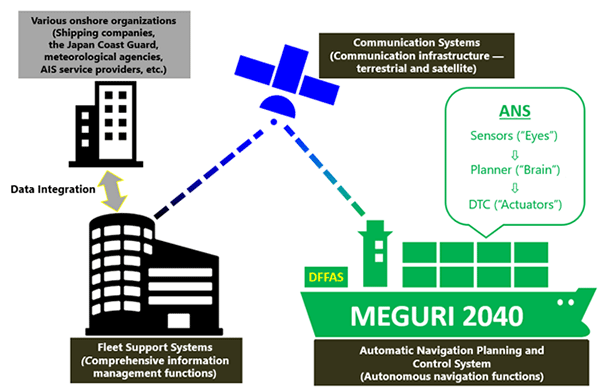
The DFFAS+ Consortium has designed and developed autonomous ships not as standalone technologies, but as integrated operational systems that combine onboard systems, communication systems, and land-based support systems.
The demonstration program covered both newly built and retrofitted vessels, including cargo ships and passenger ships with varying operational requirements. All vessels incorporate Level 4–equivalent autonomous navigation capabilities.
These systems integrate functions such as surrounding environment recognition, integrated display of navigation status, prediction of future vessel behaviour, and the formulation of collision avoidance manoeuvres and route planning. The design is based on autonomous decision-making, with human monitoring and intervention assumed when necessary.
The vessels operate in coordination with land-based Fleet Operation Centers-one permanent and one mobile-that are capable of simultaneously monitoring and supporting multiple vessels via stable satellite and mobile communication links. This configuration ensures both operational safety and redundancy.
■ Development and Implementation
As part of Stage 2 of MEGURI2040, MOL is participating in the Existing Coastal Containership Working Group. In collaboration with Imoto Lines, Ltd., TSUNEISHI SOLUTIONS TOKYOBAY Co., Ltd., and Furuno Electric Co., Ltd., MOL is advancing the automation of the existing coastal containership through retrofitting. Drawing on the operational and ship management expertise MOL has developed over many years, the company has taken responsibility for overall project coordination and risk assessment. MOL has also conducted sea trials based on the vessel’s operational profile and prepared for government inspections required for certification as an "autonomous ship."
Looking ahead, MOL remains committed to addressing key challenges facing Japan’s coastal shipping industry-including crew shortages, reducing the workload on seafarers, and ensuring safe, secure marine traffic-and to contributing to the realization of safe and reliable marine transport.
[Four Demonstration Vessels]
In Stage 2, the following four vessels-operating under different conditions and in different navigation environments-were verified for Level 4-equivalent autonomous navigation functions under commercial operations and successfully passed MLIT inspections as autonomous ships.
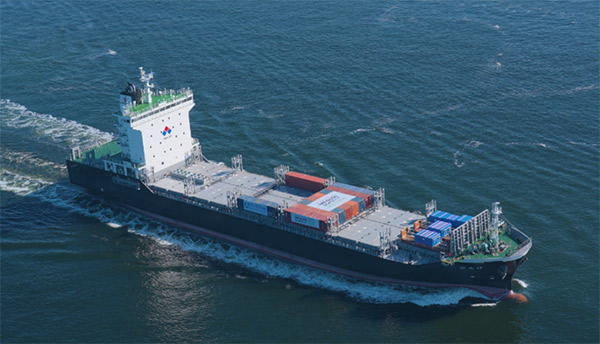
● Newly Built Coastal Container Vessel "GENBU"
GENBU is a coastal container vessel measuring approximately 134 meters in length, with a capacity of 700 TEU, maintained by IKOUS Corporation and operated by Suzuyo Marine Co., Ltd., engaged in container cargo transport on a route between Kobe and Tokyo by way of Osaka, Nagoya, Shimizu, and Yokohama. With a view to the widespread adoption of autonomous ships, the vessel was designed and constructed as a flagship equipped with all functions required for autonomous operations, and on 28 January 2026, it passed inspection by the Ministry of Land, Infrastructure, Transport and Tourism and was certified as an "autonomous ship".
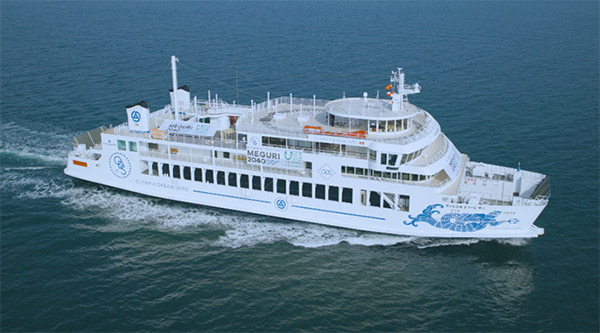
● Passenger Ship Olympia Dream Seto
Olympia Dream Seto is operated by International Ryobi Ferry Co., Ltd. It is approximately 66 meters in length and serves as a remote island ferry with a capacity of 500 passengers, linking Shin-Okayama Port (Okayama City) and Tonosho Port (Shodoshima, Kagawa Prefecture). Shipping routes in the Seto Inland Sea are congested and have many islands, reefs, and other obstacles. After safety evaluations confirmed that the system's sensors, planners, and other components operated appropriately in this environment, on December 5, 2025 the ferry received certification as an autonomous ship, becoming the first passenger ferry in Japan to do so.
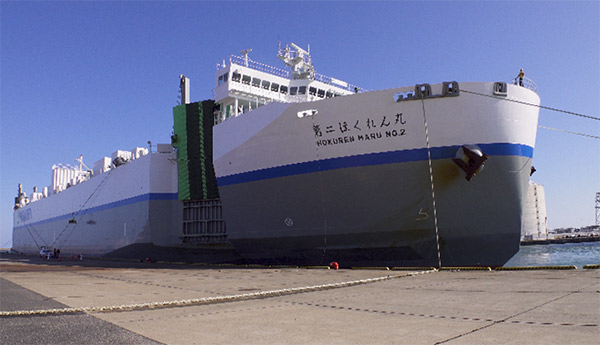
● RORO Vessel "HOKUREN MARU No.2"
HOKUREN MARU No.2 is a coastal Ro-Ro (Roll-on/Roll-off) vessel operated by Kawasaki Kinkai Kisen Co., Ltd., measuring approximately 173 meters in length with a gross tonnage of 11,413 tons. The vessel is engaged in the transportation of agricultural products, primarily fresh milk from Hokkaido, operating on the route between Kushiro Port in Hokkaido and Hitachi Port in Ibaraki Prefecture. On 9 February 2026, the vessel successfully passed the inspection as an "autonomous ship".
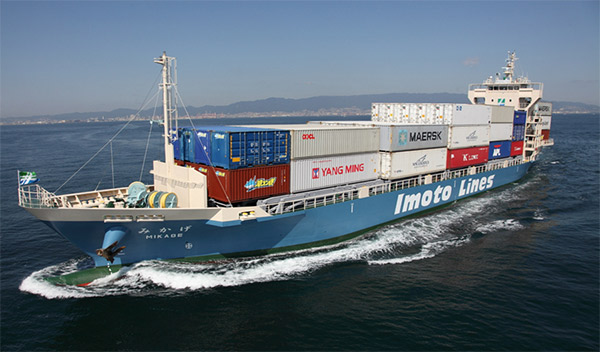
● In-Service Coastal Containership Mikage
MIKAGE is a coastal containership operated by Imoto Shipping Co., Ltd., measuring 96.81 meters in length with a capacity of 245 TEU. As the most widely used 749 GT coastal container ship type in Japan, the vessel supports domestic logistics by connecting ports throughout the country.
To promote the widespread adoption of automation in commonly used coastal vessels and contribute to the sustainable maintenance of domestic logistics, MIKAGE successfully passed the inspection as an "autonomous ship" on 25 March 2026.
(NOTE) The autonomous navigation operational area is between Kobe and Nagoya.
■ Land-based Fleet Operation Centers Supporting Autonomous Ships
In addition to onboard systems, these autonomous ships are operated safely and efficiently through monitoring and support provided by land-based Fleet Operation Centers (FOCs).
At the FOCs, real-time information such as navigational status, machinery conditions, and surrounding environmental data from multiple autonomous ships is aggregated and visualized for continuous monitoring. When necessary, navigational and decision-making support is provided, contributing to enhanced safety and reduced workload for seafarers.
At the press conference, a world-first demonstration(Note 4) was presented, in which multiple autonomous ships under commercial operation were connected in real time with the land-based Fleet Operation Centers (FOCs), enabling simultaneous support for multiple vessels.
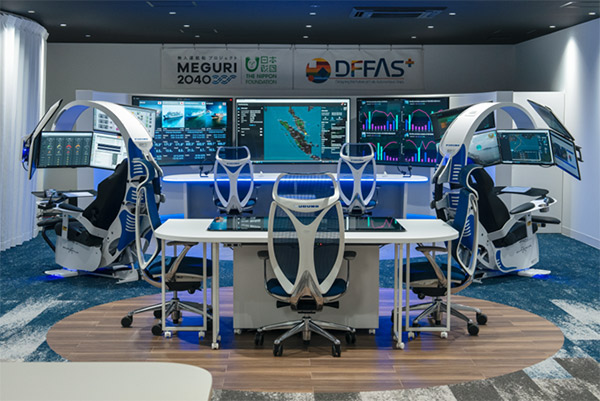
● Permanent land-based Fleet Operation Center
This is located within the headquarters of Furuno Electric Co., Ltd. in Nishinomiya City, Hyogo Prefecture. It represents the world's first operational framework that enables simultaneous navigational support from land for multiple autonomous ships operating under different purposes and navigation environments.
In addition to reducing the workload of seafarers and enhancing vessel safety, the FOC contributes to the establishment of an operational model designed to support the future widespread adoption of autonomous ships.
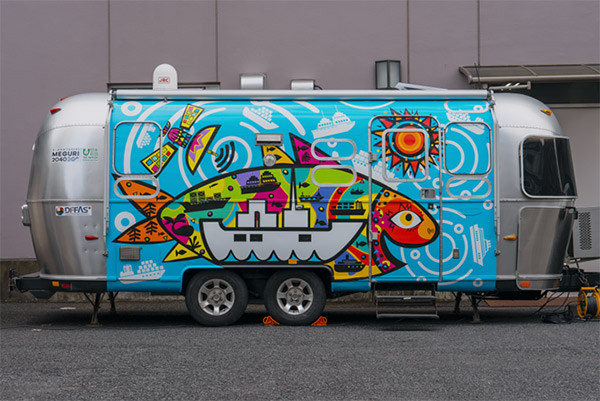
● Mobile Fleet Operation Center
This is a cargo trailer-type FOC developed primarily by Japan Radio Co., Ltd. A key feature of the mobile FOC is its ability to be relocated by towing, allowing it to move to safe locations and continue providing remote navigational support to multiple autonomous ships, even during emergencies such as natural disasters or power outages. Despite its compact size of approximately 7 meters in length, it integrates the systems required for navigation monitoring and decision-making support. It is positioned as a practical operational model designed with the future widespread adoption of autonomous ships in mind.
(Note 1) A technological level where fully autonomous navigation is partially available, Level 4 autonomy refers to fully automated operation in a designated area under specific conditions without human intervention. (The definition of automated operation for ships is currently being discussed at the International Maritime Organization (IMO). For convenience, the definition for automobiles is used.)
Cf. https://www.mlit.go.jp/common/001226541.pdf (external link, in Japanese only).
(Note 2) The Fully Autonomous Ship Project MEGURI2040 "Technology Development Grant Program for the Social Implementation of Fully Autonomous Ships"
This grant program supports technology development aimed at accelerating the practical deployment of fully autonomous ships. By fostering further momentum in this field, the program seeks to drive transformation across Japan's logistics sector as well as its broader economic and social infrastructure.
(Note 3) The Designing the Future of Fully Autonomous Ships Plus (DFFAS+) Consortium is led by Japan Marine Science Inc. Participating companies include; Akasaka Diesels Limited, IKOUS Corporation, Imoto Lines,Ltd., Weathernews Inc., Uyeno Transtech Ltd., EIZO Corporation, SK WINCH CO.,LTD., MTI Co., Ltd., NX Shipping Co.,Ltd., NTT DOCOMO BUSINESS, Inc., Kawasaki Kisen Kaisha, Ltd., KAWASAKI KINKAI KISEN KAISHA,LTD., Kawasaki Heavy Industries, Ltd., KYOKUYO SHIPYARD CORPORATION, Kinkai Yusen Co., Ltd., International Ryobi Ferry Co., Ltd., Sunflame Co., Ltd., Sanwa Dock Co., Ltd., JAPAN HAMWORTHY CO.,LTD., Japan Marine United Corporation, Mitsui O.S.K. Lines, Ltd., SKY Perfect JSAT Corporation, Suzuyo Marine Co., Ltd., Space Compass Corporation, Tsuneishi Kure Dockyard Co., Ltd., TSUNEISHI SOLUTIONS TOKYOBAY Co., Ltd., TERASAKI ELECTRIC CO.,LTD, Tokio Marine & Nichido Fire Insurance Co., Ltd., TOKYO KEIKI INC., TST Corporation, NAIKEN R&D., Nakashima Propeller Co., Ltd., Nabtesco Corporation, NIHON SHIPYARD CO.,LTD., Japan Radio Co., Ltd., Nippon Yusen Kabushiki Kaisha, The Hanshin Diesel Works, Ltd., BEMAC Corporation, pluszero, Inc., FUJIWARA SHIPBUILDING CO., LTD., FURUNO ELECTRIC CO., LTD., Honda Motor Co., Ltd., Honda Heavy Industries Co., Ltd., Marindows Inc., Marubeni Corporation, MIURA CO., LTD., Mitsui Sumitomo Insurance Company, Limited, Mitsubishi Research Institute, Inc., Mitsubishi Shipbuilding Co., Ltd., MUKAISHIMA DOCK YARD CO., LTD, YDK Technologies Co., Ltd.,
(Note 4) According to The Nippon Foundation (as of March 2026), this is the world's first instance of land-based navigational support for multiple autonomous vessels.
<MOL's press releases related to this project>
June 15, 2020: Initiative to Realize Autonomous Sailing Ready to Start Demonstration Voyages - Concluding Contract in R&D Grant Program Related to Unmanned Vessels with the Nippon Foundation –
January 25, 2022: World's First Successful Sea Trial of Autonomous Sailing on a Commercial Container Ship Voyage
February 7, 2022: MOL and Partners Set World Records for Time and Distance in Autonomous Navigation with Sea Trial Using Large Commercial Car Ferry - Follows Successful Trial of Coastal Containership in Autonomous Sailing -
July 21, 2023: Participating in the Second Stage of the Nippon Foundation MEGURI2040 Fully Autonomous Ship Project for Social Implementation