
- JP
- EN
Message
from the
CEO
Continuing to Evolve
into a Global Social
Infrastructure Company
- That's My Mission
President & CEO
Jotaro Tamura

This message is reproduced from the "MOL Report 2026."
Steadily carrying out our long-term plan based on my commitment
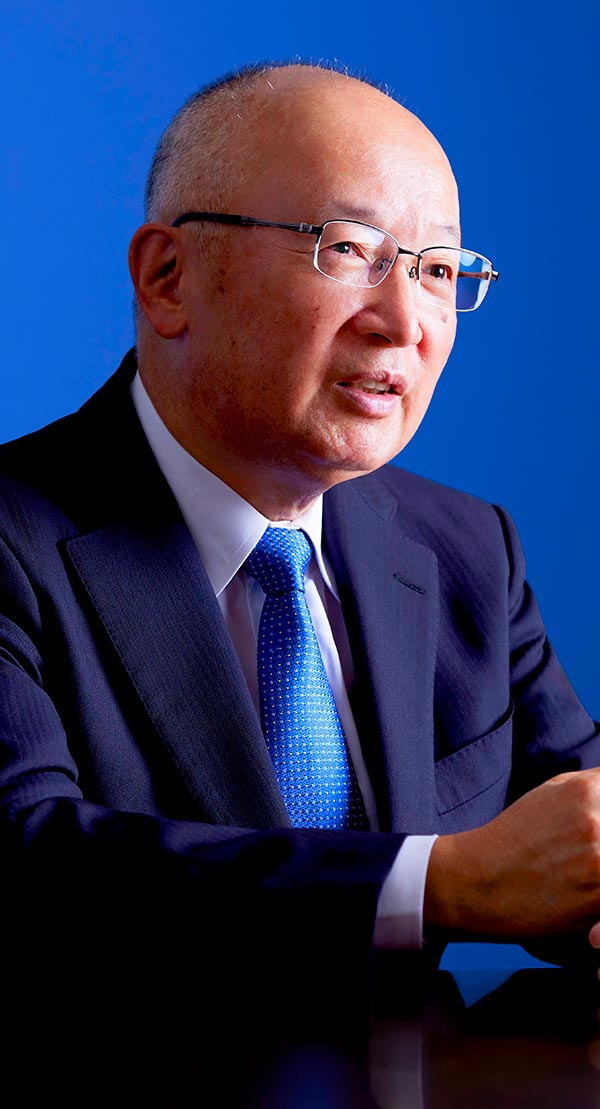
Fulfilling every mission that I have been assigned has been my focus throughout my entire career. Before I was appointed President & CEO in April 2026, I was responsible for different business areas within shipping, mostly in the containership business. I am also proud to have done my best to fulfill the missions assigned to me in multiple overseas fields, including London and Hong Kong.
Phase 2 of BLUE ACTION 2035 began at the same time as my appointment as President & CEO. When the plan was fleshed out in fiscal 2022, I was involved in its formulation as the head of corporate planning, and now I am in the position of being responsible for its fulfillment.
Let me explain once again the objectives of BLUE ACTION 2035. First, why did we create such a long-term plan of 13 years? This goes back to the dramatic changes in our positioning experienced by the Group from 2021 to 2022. It had been a little more than 10 years since the 2008 global financial crisis, and the shipping industry was struggling with a recession and a period of stagnation in which it was forced into defensive measures. However, the COVID-19 pandemic triggered a dramatic disruption in global logistics. Capitalizing on this major shift, in the two years from fiscal 2021 to fiscal 2022, we recorded ordinary profit of around ¥1.5 trillion, a scale that surpassed anything achieved in the last 30 years.
At that point, we chose not to simply reinvest the profit we earned into the shipping business. This approach came from reflecting on the prolonged deep recession following the 2008 global financial crisis, which was brought about by shipping companies rushing to simultaneously reinvest in new vessels during the strong economy of the 2000s. Additionally, management from a long-term perspective is essential in vessel lifecycles, the decarbonization transition, and portfolio rebalancing. This is why we created what could be called an ultra-long-term corporate management plan of 13 years. The vision established for the Group in that plan is already clear. To put it simply, we aim to become a global social infrastructure company and take a giant leap forward. From Phase 2 onward, I am expected to steer us steadily in this determined direction. This all comes down to making steady progress, in other words, generating economic results in line with social value to increase our corporate value.
In Phase 1, we strengthened our business foundation ahead of plan
The three-year period from fiscal 2023 to fiscal 2025 that made up Phase 1 was positioned as a period of "transformation and expansion" in which we implemented growth investment with an eye toward the future. The shipping business is, in principle, an industry with extreme market volatility. If companies invest everything into vessels during market upsides, they end up taking on all the volatility themselves. This is why in Phase 1, we shifted to a business structure less swayed by the market by directing our investment allocation toward fields within shipping with relatively low volatility and expanding investment in non-shipping businesses with strong affinities with the shipping business.
As a result, against our initial plans of ¥1.2 trillion in investment, we aggressively captured business opportunities by carrying out around ¥2.0 trillion in investment, directing around ¥1.6 trillion of that to stable revenue business. We achieved a rebalancing of our asset ratio in our market driven business and stable revenue businesses at levels exceeding our initial target of 40:60. Our average profit before tax, one of our financial KPIs, over the three years was ¥329.0 billion, largely exceeding our target of ¥240.0 billion. Looking at the details of our investments, in addition to investment in the LNG value chain business, one of our core strengths, we made LBC, a major tank terminal company handling chemical cargo in Europe and the U.S., a subsidiary. Consequently, the chemical logistics business, combined with our chemical tankers, has become a business area that is poised to become a new revenue pillar. We have also been steadily laying the groundwork for the decarbonization field, including offshore wind power, ammonia, and methanol. Overall, we made progress in building a foundation for our ideal 2035 business portfolio at a speed that exceeded our plan. Even in the current market phase of accelerating inflation, I believe that we were able to execute our investments in the stage just prior to real increases in investment costs.
However, business does not move forward simply by purchasing assets. In promoting new businesses and locally rooted businesses overseas, we are reaching the point at which our existing organization alone can no longer sufficiently serve our needs. Our challenge in Phase 2 is to quickly capture earnings from our invested businesses and to refine our business structure into one that continuously generates earnings through the power of our people and organizations.
Evolving from an integrated shipping company to a global social infrastructure company
Before I explain the steps that we plan to take to overcome these challenges, let us revisit the strengths of our Group. We are a so-called shipping conglomerate covering nearly every major segment and vessel type in shipping. While this business model has long been known as "integrated shipping" in Japan, on a global basis, specialized players in specific shipping segments are far more common. Therefore, our business model occupies a relatively unique position.
The formation of this unique business model traces back to the Group's roots. Since the 1950 and 1960s, as we supported the economic growth of Japan, an island nation dependent on shipping for both exports and imports, a business model was created that operates multiple vessel types. From the 1980s, we began to turn to overseas markets, including, of course, Europe and the U.S., but also major markets such as China and India, establishing ourselves as a major shipping player across all vessel types. We continued to develop our prowess in vessel operations with multiple vessel types, even during downturns in the shipping market, and these operational capabilities are undoubtedly one of the Group's strengths and assets.
BLUE ACTION 2035 is a plan to build on those strengths and truly develop business fields that derive from and have strong affinities with shipping, including a full-scale expansion into areas such as floating offshore facilities, tank terminals, onshore logistics, real estate, and low-carbon and decarbonized businesses. In other words, we plan to achieve our vision by combining the strengths that the Group has developed over its long history, with the capabilities and expertise of the business partners and value chains that we have acquired by expanding our business areas. Furthermore, the phrase "a global social infrastructure company" set forth in our Group Vision reflects our determination to transform ourselves from a traditional shipping conglomerate into a diversified conglomerate originating in shipping.
Phase 2: Aiming for Cyclical Growth
* Cyclical Growth
A model aimed at achieving sustainable growth over the medium to long term while absorbing the cyclical impact of the market.
Significantly increasing profit when favorable market cycles overlap
 Even during downturns in our market-driven business, the depth of our stable revenue and our mix of businesses with different levels of market sensitivity complement one another, creating a diversification effect across business segments that helps mitigate downside risk and protect our earnings
To achieve our vision, in the five-year period of Phase 2 (fiscal 2026 to fiscal 2030), the management focus will shift from "transformation and expansion" to "value realization." We have set forth three key strategic themes in Phase 2, among which "enhancing our earning power" is particularly important. The businesses targeted for upfront investment and new vessel construction that began in Phase 1 will gradually come into operation and be completed in Phase 2, when they start to generate revenue. We have also revised our business segments in Phase 2. Our businesses, which had been grouped into "market driven business" and "stable revenue business," have been reclassified into three business segments. Our containership business will be classified as a "market driven business," while our dry bulk, tanker, and car carrier businesses will be classified as "hybrid business," and our time charter business, composed mainly of long-term contracts, such as for LNG carriers, as well as our non-shipping businesses, will be classified as "stable revenue business." While the focus in Phase 1 was rebalancing our stable revenue business, Phase 2 will build upon that through strategic risk taking and capturing upside in our hybrid business. When the market is strong, we will look to capture the upside in profits from our market driven business and the exposure portion of our hybrid business. When the market is weak, we will mitigate downside risks to protect our earnings through the stable portion of our hybrid business and our stable revenue business. Delivering on both fronts is exactly what Phase 2 is built to achieve.
I believe that speed will be most important in achieving our goal of "value realization" in Phase 2. A significant factor that determines success or failure in the shipping industry is the ability to transform value chains ahead of competitors. As the direction of each business has become clear through investment in Phase 1, Phase 2 demands that we accelerate our execution pace slightly beyond our normal speed, even if somewhat burdensome, to produce results. Another key point is our ability to "win on away ground." In Phase 2, we will focus on geographical expansion and position the Indo-Pacific region, stretching from Southeast Asia to South Asia and East Africa, as the most important area for the Group. As it will be impossible to achieve our targets in our home market of Japan alone, we need to be able to win on a global scale.
Phase 2 is also the period in which we keep our sights on Phase 3 (fiscal 2031‒2035). At present, momentum toward decarbonization is slowing, but the medium- to long-term decarbonization trend has not changed. During Phase 3, it is highly likely that we will be faced with the need for large-scale vessel investment to respond to decarbonization. To prepare for this possibility, in Phase 2 it is essential that we build up our core operating cash flow and maintain financial capacity with a shareholders' equity ratio of around 40%.
Another of my goals going forward is to capture upside by taking on the appropriate level of exposure while ensuring overall downside resilience centered on the stable revenue business that we have built up in Phase 1. Put differently, while there may be some level of impact on our financial results tied to economic fluctuations, I want to demonstrate to everyone "cyclical growth*" on a long-term, sustainable basis.
* Cyclical Growth
A model aimed at achieving sustainable growth over the medium to long term while absorbing the cyclical impact of the market.
Significantly increasing profit when favorable market cycles overlap
Even during downturns in our market-driven business, the depth of our stable revenue and our mix of businesses with different levels of market sensitivity complement one another, creating a diversification effect across business segments that helps mitigate downside risk and protect our earnings
Strengthening our management foundation to achieve sustainable growth
The third key strategic theme in Phase 2 is "strengthening our management foundation." The key to "value realization," in other words, the foundation to achieve sustainable growth in our businesses, is composed solely of the strengths of our people and organizations. Furthermore, as I mentioned earlier, our operational execution capabilities across individual businesses will always be one of our assets. Meanwhile, amid this major pivot in transforming our portfolio, we are seeing both the upskilling of individuals to align with changes in our business and strong chemistry with the new talent joining our Group. Through these kinds of initiatives, I feel that the organizational structure of the Group is steadily transforming into one that combines the capabilities of diverse talent to produce new values.
One thing that I am particularly aware of is the relationship between our Head Office and our overseas organizations. For the Group's expansion to truly be supported globally, we must have an organization in which not only the talent of our Head Office, but also the talent of our various regions and locations play leading roles. I do not believe that the issue of talent diversity should be discussed merely in terms of a simple breakdown of Japanese and non-Japanese talent. I want to attract more talent that supports and can contribute to our vision of a "global social infrastructure company," regardless of their background or attributes. I also see promoting the participation of women as an essential management issue for the sustainable growth of the Group. By maximizing the abilities of all our diverse talent, we will actively work to achieve both sustainable growth and increased corporate value for the Group.
Building long-term trust through stable revenue and consistent shareholder returns
We revised our shareholder return policy to align with our Phase 2 strategy. Our price-to-book ratio (P/B ratio) was 0.78 at the end of March 2026, still below 1.0. We believe this reflects an unfavorable cycle from investors' perspective: the shipping industry performs well when market conditions are strong, but faces severe headwinds when conditions deteriorate, making it difficult to invest in and, as a result, preventing valuations from rising relative to other sectors. We also see this as an undesirable cycle. At the same time, I feel that it also indicates that our growth story has not yet been communicated effectively enough to reach investors.
In the three years of Phase 1, to ensure long-term growth potential for the Group, we carried out aggressive growth investment. In Phase 2, to advance our policy to the next stage, a key strategic theme set forth is "balanced capital allocation" in which we will enhance capital efficiency through disciplined growth investments, financial soundness, and shareholder returns. Specifically, we aim to maintain an appropriate balance between investment and financial discipline, asset recycling that includes real estate, and enhancing shareholder returns. We are making a clear shift in the basic stance of our shareholder return policy to one that both stably accumulates revenue and stably increases dividends while also making dividends highly predictable.
Particularly, in fiscal 2026, we introduced progressive dividends starting at ¥205 per share. A progressive dividend sets a definite dividend amount in principle that is followed by dividend increases, demonstrating the confidence the Group has in the earnings achieved by our stable revenue business as a result of Phase 1. Through this approach, we hope to set our shareholders' minds at ease so that even when the market is weak, the downside will be limited. Beyond that, through flexible share buybacks targeting a total payout ratio of 40% based on profit in each fiscal year, we will also return the upside of the market to our shareholders. Increasing both the predictability of dividends through progressive dividends and our capital efficiency through share buybacks are steps that we can take precisely because we are a shipping conglomerate. For example, the steps that specialized players can take against market instability are limited, but because we operate in multiple segments, we can create a structure that allows us to mitigate downside risks to protect our earnings when the market is weak and to capture the upside when the market is strong.
If we can generate profit and dividends in a predictable manner on a constant basis each year, I believe that a correction in our valuation is inevitable. Over the medium to long-term, I believe that our P/B ratio will steadily surpass 1.0, and that levels of 1.2 to 1.5 should be considered possible. In Phase 2, I would like to steadily increase the number of institutional investors and individual investors that share our Group Vision from a long-term perspective.
My commitment is to steadily advance along our chosen path
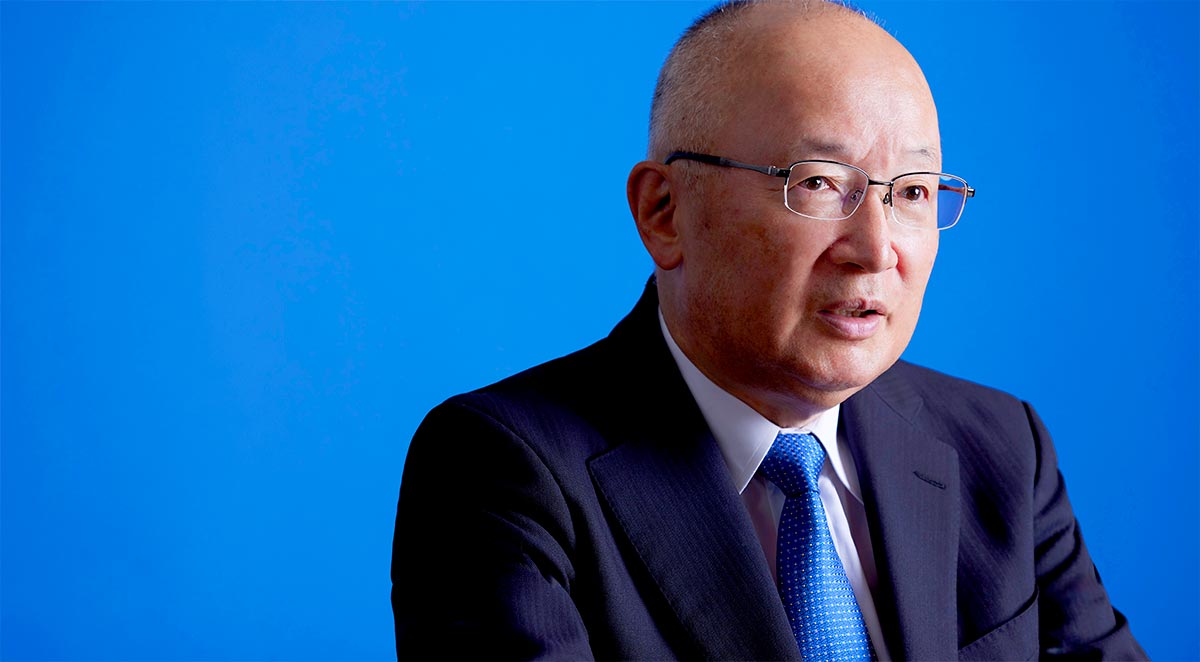
Nowadays, due to increased geopolitical risk, more people are again recognizing the social value of the shipping industry as infrastructure that safely and reliably transports the goods and resources essential to daily life, thereby sustaining the everyday lives of people around the world. Given this, if we consider what value the Group can provide for society, I believe that it is trust. Since I was appointed as President & CEO, I have had the opportunity to speak with many people whom I had not previously met, and in these conversations, I truly realized that the MOL Group is a trusted presence. This is why customers trust us to transport their precious cargo, and our employees wish to work for the Group.
Approximately 20,000 people support the operations of the Group. Around half of those people are seafarers, the majority of whom are from the Philippines and India. A month after being appointed as President & CEO, I visited India and the workers told me that they had chosen the Group because they wanted to work for a top-class carrier and sail on MOL vessels. I believe it is precisely because we have this foundation of trust that we will continue to be the company chosen by all stakeholders.
We are still in the stage where we are seen by most people as a Japanese global shipping company or a Japanese company that operates a global infrastructure business. Moving forward, I would like to demonstrate our unique positioning as a "global social infrastructure company" by clearly articulating what we do in practice and what we have achieved. I would also like to take a step beyond being seen through the broader lens of simply one of many companies in the shipping industry or just another Japanese company and enhance our appeal in a way that transcends boundaries.
As I explained here, BLUE ACTION 2035 is a long-term plan aimed at the integrated creation of economic value and social value to realize our Group Vision. What I can commit to our investors and shareholders is that I will not lose sight of our long-term management perspective and that I will steadily advance along our chosen path. I hope you will look forward to what lies ahead for our Group.
This message is reproduced from the "MOL Report 2026."