
- JP
- EN
September 15, 2026
Approval in Principle (AiP) Acquired for Standard Low-Pressure Liquefied CO2 Carrier toward Realization of CCS Business in Japan
- First Successful Result for a Standard Design Framework Utilizing MILES -
Mitsui O.S.K. Lines, Ltd. (MOL)
Kawasaki Kisen Kaisha, Ltd. ("K" LINE)
Nippon Yusen Kabushiki Kaisha (NYK Line)
Nihon Shipyard Co., Ltd. (NSY)
MILES Co., Ltd.
Mitsubishi Shipbuilding Co., Ltd.
* AiP acquired after completing risk assessment of CO2 handling operations specific to low-pressure liquefied CO2 carriers and establishing a safety-focused design policy
* Utilizes the MILES-based standard design framework to ensure stable construction and supply of liquefied CO2 carriers in Japan while improving economic efficiency
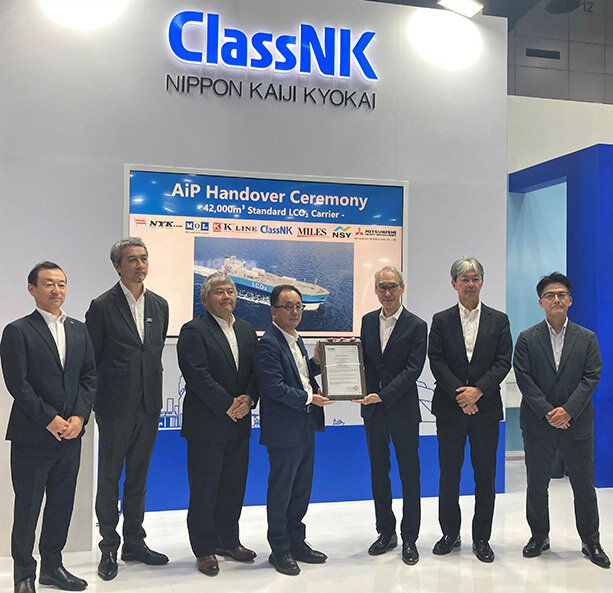
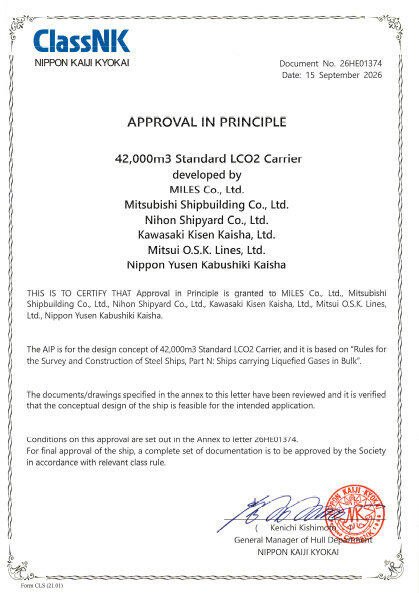
Tokyo, September 15, 2026 – Six companies, including Mitsui O.S.K. Lines, Ltd. (MOL), Kawasaki Kisen Kaisha, Ltd. ("K" LINE), Nippon Yusen Kabushiki Kaisha (NYK Line), Nihon Shipyard Co., Ltd. (NSY, a ship design and sales joint venture between Imabari Shipbuilding Co., Ltd. and Japan Marine United Corporation), Mitsubishi Shipbuilding Co., Ltd., a part of Mitsubishi Heavy Industries (MHI) Group, and MILES Co., Ltd. (a joint venture among related companies for the design of liquefied CO2 (LCO2) carriers and low-carbon fueled ships) have obtained Approval in Principle (AiP)*1 for a low-pressure LCO2 carrier from the Japanese classification society Nippon Kaiji Kyokai (ClassNK) following completion of a risk assessment for LCO2 handling operations. A ceremony to present the AiP was held on September 15 at Gastech 2026 in Bangkok, Thailand.
Demand for LCO2 carriers is expected to grow as a series of CCS (Carbon dioxide Capture and Storage) projects commence in Japan, requiring a means of transporting CO2 captured in Japan to storage sites. Based on a Memorandum of Understanding*2 announced on December 1, 2025, the six companies have been advancing a standard design framework that utilizes MILES for LCO2 carriers and alternative-fuel ships. Their goals include the stable domestic construction and supply of LCO2 carriers, the standardization of LCO2 carriers, and the establishment of a CCS value chain. This AiP marks the first concrete achievement through the MILES framework.
The six companies conducted a risk assessment (Hazard Identification Study "HAZID")*3 for LCO2 handling operations on a low-pressure 42,000m3 class LCO2 carrier, which is being standardized. The risk assessment drew on the extensive experience of "K" LINE, MOL, and NYK Line in low-pressure gas carrier operations to consider the risks unique to low-pressure LCO2. A design policy stressing safety was established based on the findings, leading to the acquisition of the AiP. This policy will be reflected in the standard design of LCO2 carriers and will serve as an important foundation for supporting CCS business development in Japan. A common design platform for a standard vessel is expected to provide workload savings and greater efficiency in design and construction going forward, strengthening construction capabilities.
The MOL Group has positioned environmental strategy as one of the core pillars of its management plan, "BLUE ACTION 2035." Under "MOL Group Environmental Vision – BLUE ACTION 2035 Phase 2," the MOL Group has set a target of expanding low-carbon and decarbonization businesses, and this initiative forms part of this commitment.
In MOL's CCS business, we have already entered into long-term charter contracts for two LCO2 carriers that MOL plans to own for Northern Lights Project, the world's first full-scale CCS project. These two vessels are scheduled to commence CO2 transportation services for CCS operations around 2028.
Looking ahead, MOL will continue to actively participate in the development of the CO2 value chain and contribute to the realization of a decarbonized society by meeting the rapidly growing demand for maritime CO2 transportation.
Notes
*1: Approval in Principle (AIP) indicates that a certification body has reviewed the basic design of the subject equipment, and confirmed that it meets technical requirements and relevant safety standards. The inspection of the basic design for the LCO2 carrier was conducted in accordance with ClassNK's "Rules For the Survey and Construction of Steel Ships (Part N Ships Carrying Liquefied Gases in Bulk)."
This is the first AiP received for a standard design scheme utilizing MILES, and for the 42,000m3 class ship type.
Ref. Approval in Principle (AiP) Acquired from Two Classification Societies for Low-Pressure Type Liquefied CO2 Carriers undergoing Pursuit of Standardization toward Realization of Large-Scale International Transportation from 2028 onwards | Press Release | Mitsui O.S.K. Lines, Ltd. ( September 18, 2024 )
*2: Memorandum of Understanding Concluded on Establishing a Standard Design Framework Utilizing MILES for Liquefied CO2 Carriers and Alternative Fuel Ships | Press Release | Mitsui O.S.K. Lines, Ltd. ( December 1, 2025 )
*3: A Hazard Identification Study (HAZID) is a safety assessment method for plants and systems to identify potential risks (hazards) in design concepts, and evaluate the extent of those risks and the effectiveness of mitigation measures.