- JP
- EN
June 18, 2026
MOL Signs Deal to Supply Bio-LNG Fuel for Car Carriers in Europe
- Accelerating the Use of Clean Fuels in the Drive Toward Net-Zero Emissions by 2050 -
Mitsui O.S.K. Lines, Ltd. (MOL; President & CEO: Jotaro Tamura; Headquarters: Minato-ku, Tokyo) has signed new supply agreements in Northern Europe and the Mediterranean region to expand the use of bio-LNG fuel on MOL-operated LNG-fueled car carriers.
Titan, part of Molgas (Vice President Marine: Niels den Nijs; Headquarters: Amsterdam) will continue to supply Bio-LNG fuel in Northwest Europe, while Axpo (CEO: Christoph Brand, Chairman: Roland Leuenberger; Headquarters: Baden, Switzerland) will take charge of supply in the Mediterranean region.
This agreement makes it possible for our company to supply bio-LNG fuel for automobile carriers in the Mediterranean region (Port of Malaga and Barcelona, Spain), following the bio-LNG fuel supply agreement (Note 1) in Western Europe, which commenced in March last year.
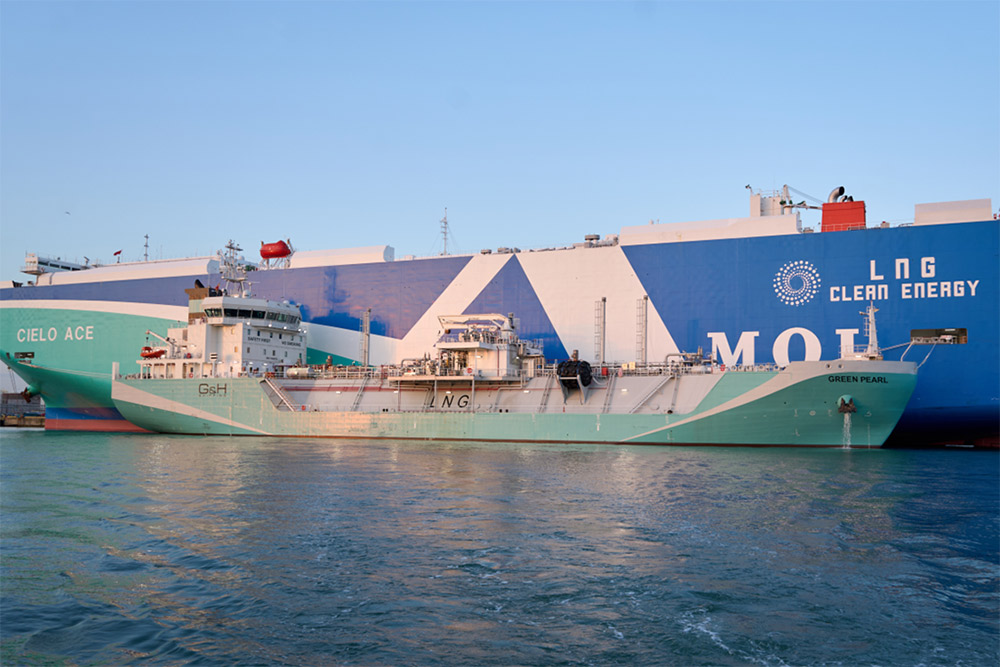
Bio-LNG fuel is liquefied methane produced primarily from biomass such as livestock manure and food waste. It is an immediately available clean fuel that can contribute to carbon neutrality by significantly reducing lifecycle greenhouse gas (GHG) emissions while utilizing the LNG fuel supply infrastructure already in place.
The bio-LNG fuel to be supplied in this initiative has a lifecycle carbon intensity (carbon dioxide emissions per unit of energy consumption) of -15 g-CO2/MJ or less, from production through consumption. Furthermore, this bio-LNG fuel has obtained International Sustainability and Carbon Certification (ISCC-EU) (Note 2). By replacing conventional marine fuels with such biofuels, we contribute to reducing greenhouse gas emissions.
Through this supply agreement, MOL has established a framework that ensures a continuous and stable supply of bio-LNG fuel not only in Northern Europe but also in the Mediterranean. As part of the group's efforts to adopt alternative fuels and achieve net-zero greenhouse gas (GHG) emissions-key actions outlined in the "MOL Group Environmental Vision"-it is utilizing LNG-fueled vessels as a bridge solution to facilitate the transition to carbon-neutral fuels such as bio-LNG and synthetic LNG (e-methane).
Going forward, MOL will step up its efforts to reduce GHG emissions by expanding the geographic reach, volume, and quality of its bio-LNG fuel usage. The group will also drive the development of clean fuel supply chains and lead the shipping industry's initiatives to achieve net-zero emissions. In parallel with the expansion of its LNG-fueled fleet, MOL will continue to promote the adoption of a diverse range of next-generation fuels-including biofuels, methanol, ammonia, and hydrogen-and contribute to the realization of a sustainable society while ensuring safe operations.
(Note 1) In 2025, MOL signed a bio LNG fuel supply agreement in Northwest Europe with Titan, part of the Molgas (Vice President Marine: Niels den Nijs; Headquarters: Amsterdam), and MOL has continued this bio LNG fuel supply agreement with the same company in 2026 as well. Please refer to the following news release.
MOL Starts Use of Bio-LNG Fuel for Car Carrier Celeste Ace - Key Milestone toward Achieving Net Zero Emissions by 2050 -
(Note 2) ISCC-EU certification (International Sustainability and Carbon Certification) is a certification system established under the European Renewable Energy Directive (RED III). It verifies that sustainable fuels produced from biomass or waste comply with the EU's legal requirements for sustainability and greenhouse gas emission reduction standards.
The MOL Group Sustainability Issues
MOL Group identifies "Sustainability Issues" (Materiality) as our key issues for sustainable growth with society through realization of the Group Vision.
We anticipate this initiative to contribute especially to the realization of "Environment."