
- JP
- EN
February 26, 2026
MOL Succeeds in World's 1st LED Lighting Experiment Powered by Seafloor Hydrothermal Energy Through NEDO R&D Project
TOKYO-Mitsui O.S.K. Lines, Ltd. (MOL; President & CEO: Takeshi Hashimoto) today announced that it has completed the world's first successful LED lighting demonstration test utilizing "Seafloor Hydrothermal fluids" (Note 1), a renewable energy source derived from magma heat in the Central Okinawa Trough. The test was conducted as part of the "Hydrogen Society Construction Technology Development Project / Regional Hydrogen Utilization Technology Development" (Note 2) backed by the New Energy and Industrial Technology Development Organization (NEDO). This achievement demonstrates the potential to use thermal energy from seafloor hydrothermal vents as a new domestic renewable energy source.
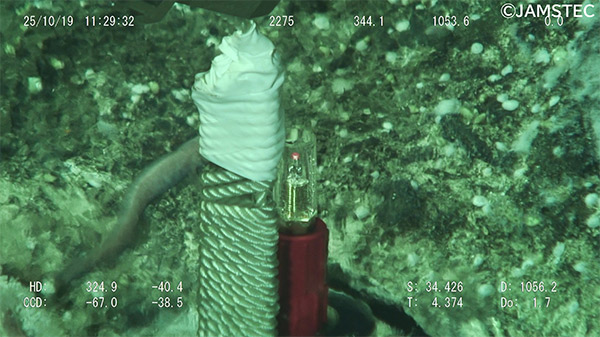
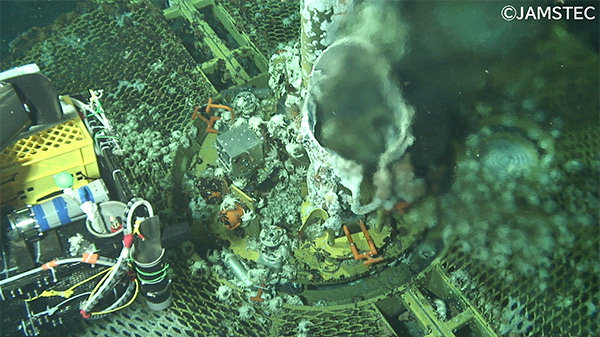
Through NEDO funding, this project is being implemented under MOL's overall management in collaboration with the Japan Agency for Marine-Earth Science and Technology (JAMSTEC), the National Maritime Research Institute, Tokyo University of Marine Science and Technology, Geothermal Energy Research and Development Co.,Ltd, and elleThermo, Ltd. (Note 3). In this experiment, we confirmed that electricity generated from hydrothermal fluids erupting from seafloor hydrothermal vents in the Central Okinawa Trough can continuously power underwater LED lights for a designated period. This represents the world’s first demonstration test of powering LEDs with thermal energy from seafloor hydrothermal fluids in a real ocean environment. We also obtained foundational data on temperature conditions, power generation performance, and durability under subsea environmental conditions.
This experiment was supported by Cooperative Research Program of Atmosphere and Ocean Research Institute, the University of Tokyo (Research Vessel Shinsei Maru, KS-25-14 Cruise / Chief Scientist Tomonori Ihara, Tokyo University of Marine Science and Technology, JURCAOSS25-39).
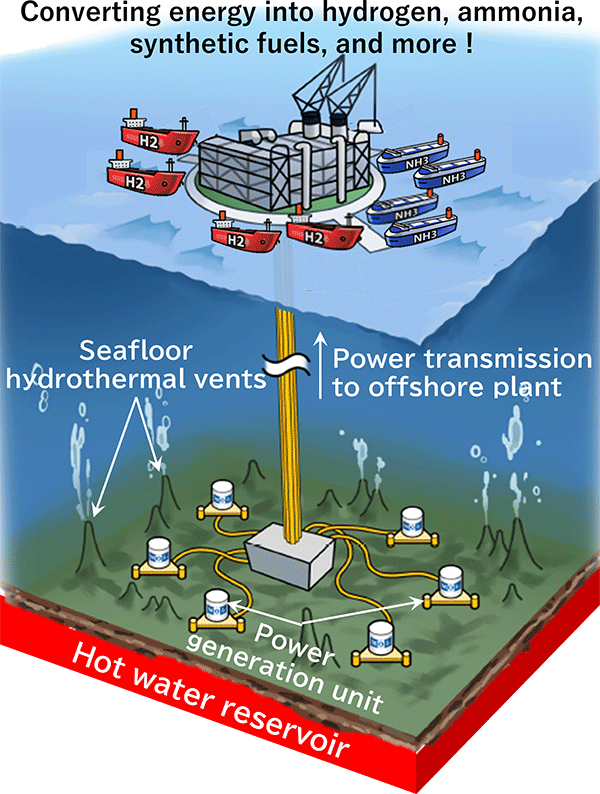
Based on these results and estimates indicating a potential power generation capacity of up to 60 GW (Note 4) in areas such as the Central Okinawa Trough, we will advance the project in stages through hydrothermal resource surveys in other sea areas, the development of power generation modules, and long-term continuous test operations. We will also work with relevant organizations to jointly verify the technical and economic feasibility of the entire value chain, from power generation at the seabed to production of hydrogen, ammonia, and synthetic fuels at offshore plants, to supplying fuel for a wide range of applications, including vessels. The project aims to commercialize a zero-emission fuel model based on seafloor hydrothermal resources.
Through this project, MOL will further strengthen its zero-emission fuel business, as outlined in its environmental vision, "MOL Group Environmental Vision 2.2," which prioritizes the energy transition. This initiative will accelerate decarbonization and the creation of new businesses in the shipping and energy sectors.
MOL will proactively advance research, development, and demonstration tests toward the commercialization of ocean renewable energy, which holds significant potential as a natural energy source, thereby contributing to the realization of a sustainable energy society.
(Note 1) Seafloor hydrothermal fluids themselves represent a stable, domestically sourced renewable energy resource that draws on magma as a heat source, enabling electricity generation that is unaffected by weather or time of day.
(Note 2) For details, please refer to the link below.
Announcement of the Project Implementation Framework for FY2024 "Hydrogen Society Construction Technology Development Project/Regional Hydrogen Utilization Technology Development" | Call for Proposals | NEDO
(Note 3) elleThermo, Ltd. aims to address energy and resource challenges safely and securely without reliance on conventional resources. The company is working toward the social implementation of power supply systems that utilize untapped waste heat through its core technology, the "Semiconductor Thermal Conversion (STC)" device, developed at Institute of Science Tokyo (formerly Tokyo Institute of Technology).
(Note 4) Equivalent to approximately 30% of Japan's annual electricity generation.
MOL Group 5 Sustainability Issues
MOL Group identifies "Sustainability Issues" (Materiality) as our key issues for sustainable growth with society through realization of the Group Vision.
We anticipate this initiative to contribute especially to the realization of "Environment -Conservation for Marine and global environment-" and "Innovation -Innovation for development in marine technology-".