
- JP
- EN
March 05, 2026
Establishment of the Japan-New Zealand Hydrogen Corridor
-Study begins toward commercializing hydrogen production in New Zealand and export operations to Japan-

Mitsui O.S.K. Lines, Ltd.
OBAYASHI CORPORATION
Kawasaki Heavy Industries, Ltd.
Chiyoda Corporation
Mitsui O.S.K. Lines, Ltd. (Head Office: Minato-ku, Tokyo; Representative Director, President and Chief Executive Officer: Takeshi Hashimoto), OBAYASHI CORPORATION (Head Office: Minato-ku, Tokyo; Representative Director, President and CEO: Toshimi Sato), Kawasaki Heavy Industries, Ltd. (Head Office: Minato-ku, Tokyo; Representative Director, President and Chief Executive Officer: Yasuhiko Hashimoto), and Chiyoda Corporation (Head Office: Yokohama, Kanagawa Prefecture; Representative Director, President & CEO: Koji Ota) established the Japan–New Zealand Hydrogen Corridor on March 5. The consortium will study the commercialization of green hydrogen production in New Zealand and export operations to Japan.
Hydrogen is expected to play a key role as a clean energy source that does not emit CO2 when burned. Its use is anticipated in the mobility sector, in energy transitions in industries such as steel and chemicals, where reducing greenhouse gas emissions is particularly challenging, and in applications such as co-firing at thermal power plants. Meanwhile, Japan has a low energy self-sufficiency rate, and renewable energy accounts for only a limited share of total energy consumption (Note 1). For this reason, we believe that meeting future large-scale demand for green hydrogen solely through domestic supply will be difficult.
New Zealand has abundant renewable energy resources, including geothermal power and hydropower, which are essential for green hydrogen production (Note 2). With the government also announcing a policy to prioritize the development of its hydrogen industry (Note 3), the country is expected to become a leading hub for green hydrogen production and supply in the Asia-Pacific region in the future. In addition, imports of green hydrogen from New Zealand, which maintains strong diplomatic and trade relations with Japan, are also expected to make a significant contribution to advancing Japan's decarbonization and strengthening its energy security from the standpoint of establishing a sustainable energy supply under stable international relations.
Under the Japan–New Zealand Hydrogen Corridor, studies will begin in fiscal 2026 to build a hydrogen supply chain originating in New Zealand and to enable the export of green hydrogen from New Zealand to Japan, with imports and exports commencing in the early 2030s. Looking ahead, the initiative aims for New Zealand to become a leading green hydrogen supply hub for Japan, contributing to carbon neutrality in Japan and to the creation of a new export industry in New Zealand. Activities will be carried forward toward these goals.
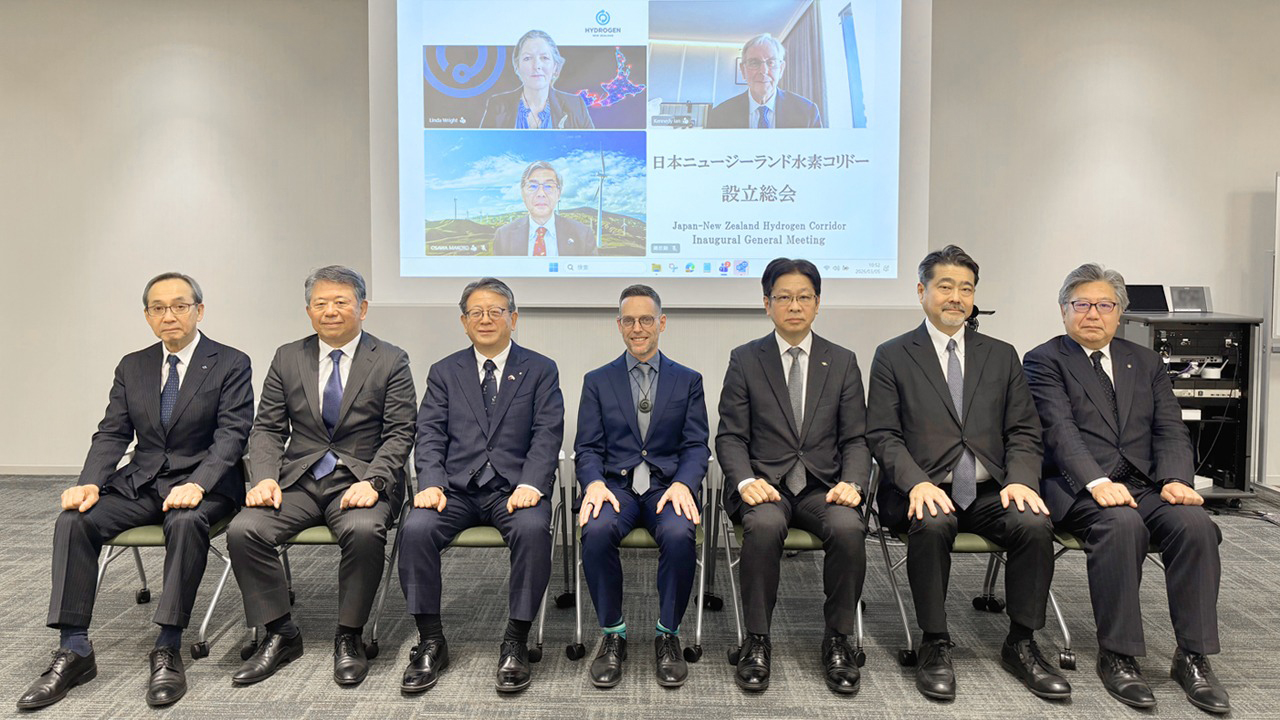
(From the top left of the screen)
Linda Wright, New Zealand Hydrogen Council Chief Executive, Ian Kennedy, Chair, New Zealand Committee for the Japan-New Zealand Business Council, Makoto Osawa, Ambassador Extraordinary and Plenipotentiary to New Zealand
Akira Ichikawa, Chair, Japan Committee for the Japan-New Zealand Business Council(far left)
Gareth Pidgeon, Deputy Head of Mission and Consul-General, New Zealand Embassy in Tokyo(center)
Hiroshi Fukushima, Japan Hydrogen Association Executive Director (far right)
Participating Companies in the Japan–New Zealand Hydrogen Corridor
| Chair | Kenichi Ando | Senior Managing Executive Officer, Head of Green Energy Division, OBAYASHI CORPORATION |
|---|---|---|
| Vice Chair | Motohiko Nishimura | Senior Managing Executive Officer, President, Kawasaki Heavy Industries, Ltd. |
| Vice Chair | Hirofumi Kuwata | Executive Vice President Executive Officer, Chief Operating Officer, Mitsui O.S.K. Lines, Ltd. |
| Director | Toshiyuki Ito | Vice President, Frontier Business Division, Chiyoda Corporation |
(Note1) As of fiscal year 2023, Japan's energy selfsufficiency rate stands at approximately 15.3%, while renewable energy (including hydropower) accounts for about 22.9% of total electricity generation.
For further details, please refer to the News Release issued by the Agency for Natural Resources and Energy, Ministry of Economy, Trade and Industry (April 25, 2025).
(Note2) New Zealand maintains a remarkably high share of renewable energy. As of 2024, approximately 45.5% of its total primary energy supply is derived from renewable sources, and about 85.5% of its electricity is generated from renewable energy such as hydropower, geothermal, and wind.
For further details, please refer to Energy in New Zealand 25 | Ministry of Business, Innovation & Employment.
(Note3) In November 2024, the New Zealand Government announced its Hydrogen Action Plan, outlining a policy to expand a low emission hydrogen market driven by private sector initiatives, supported by the reduction of regulatory barriers and improvement of the investment environment.
For further details, please refer to Hydrogen Action Plan.