
- JP
- EN
Pre-emptive Management of Risk and Dangers
Working Closely with Shipyards
Vessels used in our group's business are procured from domestic and overseas shipyards. To ensure that vessels are built safely and to the highest quality standards, we appropriately assign resident supervisors with technical expertise to each project to oversee the construction process.
Shipbuilding supervisors have the following three duties at the shipyard:
- Quality Management
Quality management verifies that shipyards reliably meet required specifications that contribute to safe operation, rules for each ship type, and other standards. - Process control
We stay on top of day-to-day management to avoid situations that may affect the delivery schedule and allow us to take swift action in case of an emergency. - Health, Safety and Environment (HSE) management
Before the start of construction, we check the differences between the safety guidelines of each shipyard and the "Health Safety Environment (HSE) Manual" prepared by the MOL Group, and share all the details in advance with the superintendents we will dispatch to the construction site. We strive to improve occupational health and safety at shipyards by pointing out potential violations of laws and regulations and urging shipyards to make improvements, and by introducing outstanding examples from other companies.
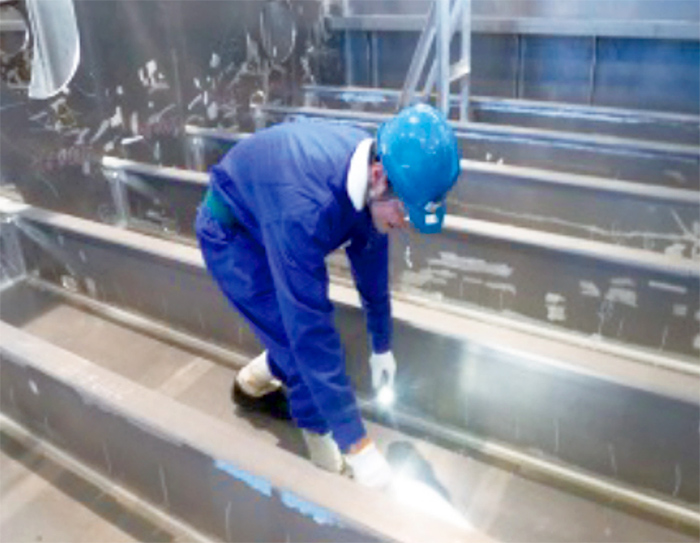
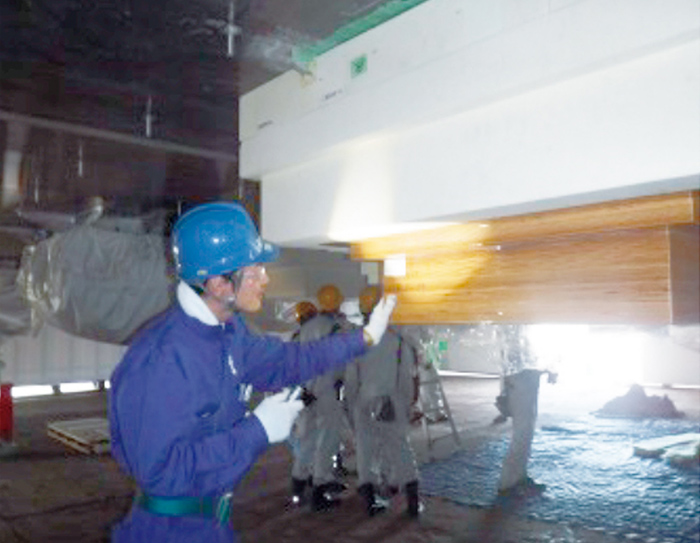
They work on-site at the shipyard for one to two years from the initial stage (about a month after steel cutting) to the completion of the vessel.
Accident Response Drills
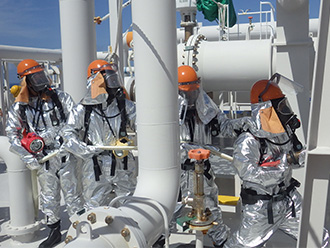
We continuously conduct training to ensure appropriate responses in the event of an emergency or trouble.
On board, we regularly conduct emergency response drills for fire, flooding, and other situations. Furthermore, MOL Group companies that operate ferries and cruise ships conduct regular emergency response drills, including evacuation guidance, as they put the highest priority on ensuring customer safety in an emergency.
On land, once a year at the head office, the president and other relevant officers, relevant departments, and ship management companies jointly conduct emergency response drills in anticipation of serious marine accidents. The purpose of this training is to raise safety awareness of MOL as a whole by simulating a serious marine accident, and to confirm that the necessary response and information transfer can be conducted accurately and smoothly in the event of a serious marine accident.
By sharing and improving the know-how accumulated through this training and newly discovered issues, we will further strengthen our emergency response system for emergencies.
Initiatives Against Geopolitical Risks and Natural Disaster Risks
Pirates and robberies
In the Gulf of Guinea, off the coast of the Gulf of Aden and Somalia, and in the Straits of Singapore, where there is a risk of piracy occurring, we are strengthening surveillance on ships by increasing the number of lookouts using radar and night vision, and by increasing the number of lookouts.
To ward off pirate attacks, the ship is equipped with razor wire and crew members wear bulletproof vests and helmets. In the event that there is a high risk of being boarded by pirates, the crew will be evacuated to an evacuation area called the Citadel to prevent any harm to the crews until the rescue of warships arrives.
On land, our Safe Operation Support Center (hereinafter SOSC) shares information on piracy and other incidents with vessels navigating in dangerous waters to raise awareness. In addition, a monitoring system is used 24 hours a day to check whether vessels are implementing prescribed measures such as speed increases in accordance with the navigation guidelines established by our company.
Terrorism
It is very difficult to predict terrorist acts, but when we receive information that an incident has occurred, the SOSC disseminates the information to vessels operating in the vicinity and related parties without delay to alert them.
In particular, the situation remains tense in the Middle East, including the Persian Gulf, the Gulf of Oman, the Red Sea, and the Arabian Sea, with attacks on vessels. When entering such high-risk waters, we take all necessary security measures, such as increasing the number of lookouts, rechecking fire extinguishing equipment in preparation for fires, and avoiding navigation in coastal areas.
In addition, on land, we understand the status of vessels scheduled to enter the Middle East, and continuously collect security information on the situation in the Middle East and incidents of attacks from industry organizations, security investigation companies, and vessels navigating in the vicinity so that we can take prompt action when we receive security information that is a concern for safe navigation.
Conflict areas
Information on political instability, military conflicts, and other security-related developments around the world is continuously monitored through various media sources as well as multiple security intelligence providers. When events that may affect vessels operated by our group are identified, relevant information is promptly shared with internal stakeholders to enable timely and appropriate countermeasures.
In addition, before calling at ports in countries with security concerns or navigating specific sea areas, we obtain risk assessments from specialized security intelligence providers. For areas deemed to pose particularly high risks, we prioritize the safety of our crew members, vessels, and cargo by establishing our own navigation guidelines, including avoidance zones and other necessary security measures.
Furthermore, the Safety Operation Support Center (SOSC) continuously monitors vessel movements based on these navigation guidelines and promptly provides relevant information and operational support to affected vessels whenever necessary.
Natural disaster risks
Typhoons and other natural phenomena such as stormy weather can sometimes cause serious damage to vessels.
In particular, earthquakes and tsunamis occur suddenly and are difficult to predict.
It is therefore very important to collect all available information in a timely manner and to conduct risk management for vessel navigation, an essential element for safe operation.
In order to ensure the safety of crew and cargo from natural disaster risks, MOL has established the Safety Operation Support Center (SOSC) with two staff members on duty at all times, including one who has experience as a captain, to monitor vessel movements 24 hours a day and the forecast information for weather and sea conditions.
In the event of an accident or trouble on a vessel caused by a natural disaster, the Center provides necessary information to the vessel and related departments on shore and supports the captain and operators to help them make the appropriate decisions.
ICT supporting safe operation
The Safety Operation Supporting Center (SOSC) monitors and supports operating vessels based on information obtained from various systems and sources. This section introduces the ship motion monitoring system and the stranding risk monitoring system, which are representative of these systems.
vessel movement monitoring system
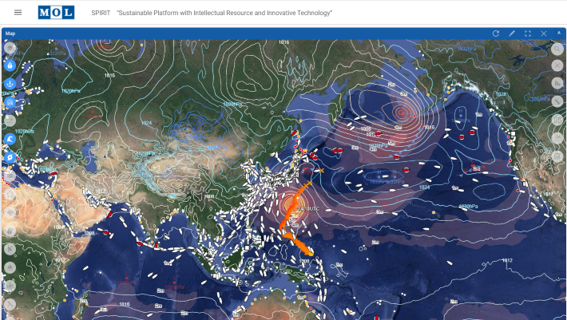
SPIRIT (Sustainable Platform with Intellectual Resource and Innovative Technology) is a monitoring system that has been in operation since January 2021, enabling us to track the location of our operated vessels worldwide and monitor the weather and sea conditions surrounding them.
In addition to being used by the Safety Operation Support Center (SOSC) for continuous monitoring, the system is also utilized by vessel operation personnel and other relevant employees to support vessels in operation.
SPIRIT combines weather and oceanographic data with information on piracy, military exercises, and High Risk Areas (HRAs) to conduct risk assessments and vessel monitoring. Since April 2022, voyage plans submitted by vessels have also been incorporated into the system, further enhancing operational support capabilities.
Furthermore, we have introduced an AI-powered Risk Management System that integrates and visualizes a wide range of information that was previously managed separately, including weather and oceanographic data, voyage and operational data, and geopolitical intelligence.
By analyzing these data sets, the system identifies and prioritizes critical events that may require attention, helping SOSC personnel assess situations and make informed operational decisions.
As a result, decision-making processes that previously relied heavily on individual expertise have been enhanced, enabling faster and more accurate operational decisions.
grounding risk monitoring system
Grounding risk monitoring system, that combines a number of data sources, such as ship position, water depth, and chart information, to alert SOSC operators when a vessel is judged to be entering an area with a high risk of grounding.
SOSC, which monitors vessels in operation 24 hours a day, 365 days a year, constantly monitors the system and initiates the system when an alert is issued.
Ship Inspections
Fleet-wide Risk Visualization
MOL conducts periodic ship inspections, based on our unique safety standards, targeting all MOL Group-operated vessels, regardless of whether they are owned or chartered.
These inspections verify that the vessels are properly maintained and can operate safely and reduce the risks that may impede with the safe operation of the vessel.
With chartered vessels, we communicate closely with the shipowners and assigned ship management companies, to make sure they have a full understanding of the safety standards we require. We also cooperate with them to pursue safety measures while building mutually trusting relationships.
In addition, we are working to consolidate and analyze data and insights obtained through these vessel inspection activities and corrective actions on a company-wide basis. Through these efforts, we aim to visualize the locations and trends of risks related to safe operations.
Enhancing Risk Management and Quality Control through Inspections, Corrective Actions, and Data Analysis
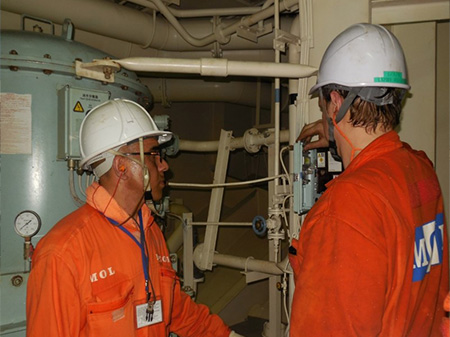
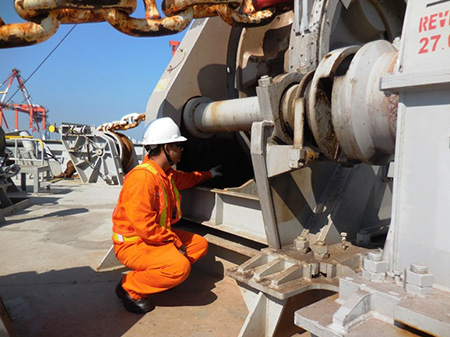
A team of two ship inspectors, who have a thorough knowledge of MOL's safety standards, personally visit ships and conduct detailed investigations based on our own checklist, such as the vessels' operational and maintenance status of the vessel, ship management status, and so on.
Even when it is difficult to visit vessels due to various circumstances, the remote vessel inspection (Examine photographs or video images, Documents, Questionnaires, etc. from shipowners and ship management companies) is continued.
If they spot an unsafe or non-conforming condition, they make sure the vessel and its ship management company take appropriate corrective measures so the ship meets MOL's strict safety standards.
Their completed report, which covers the entire inspection and is illustrated with photographs, is circulated among relevant divisions including the responsible business division. Thus, the quality of the vessel is confirmed. In the case of chartered vessels, the shipowner receives any corrective guidance through the business division. By accumulating and analyzing information, including the outcomes of these corrective actions, we work to prevent the recurrence of risks and continuously enhance our safety management practices. This consistent, professional approach ensures the safety of both owned and chartered ships.
- Sustainability TOP
- Message from the Chief Sustainability Officer
- Sustainability
Management - Value Creation
Stories - Environment
- Safety
- Human Capital
- Digital Transformation
- Governance
- Social Contribution
Activities - Stakeholder
Engagement - Sustainable Finance
- Sustainability Data
- ESG Disclosure
Guideline Indexes - External Recognition
- Library