
- JP
- EN
MOL Group Environmental
Vision
For Bluer Oceans
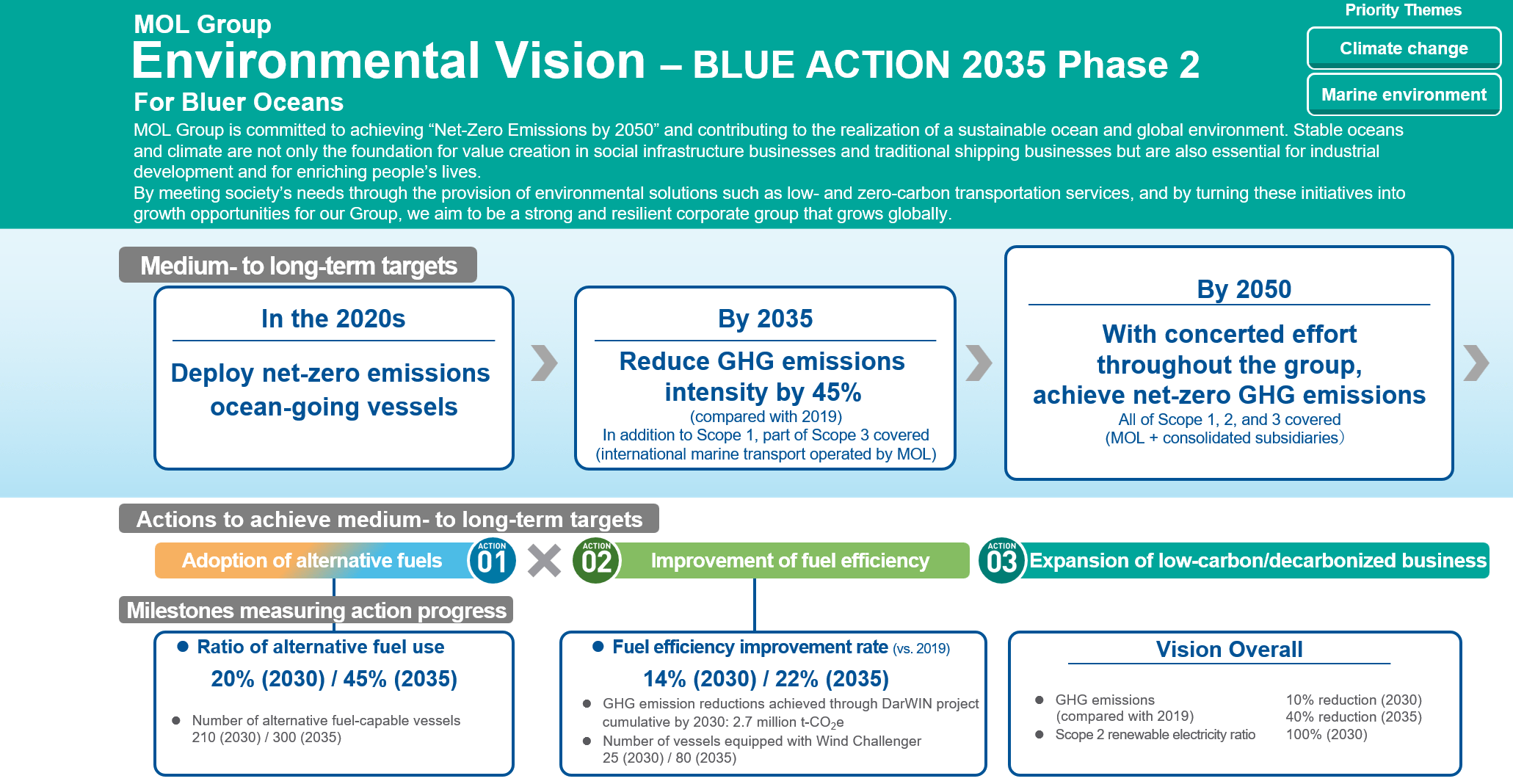
MOL Group is committed to achieving "Net Zero Emissions by 2050" and contributing to the realization of a sustainable ocean and global environment. Stable oceans and climate are not only the foundation for value creation in social infrastructure businesses and traditional shipping businesses but are also essential for industrial development and for enriching people's lives. By meeting society's needs through the provision of environmental solutions such as low‑ and zero‑carbon transportation services, and by turning these initiatives into growth opportunities for our Group, we aim to be a strong and resilient corporate group that grows globally.
In April 2026, in conjunction with the formulation of Phase 2 of our corporate management plan, BLUE ACTION 2035, we updated the MOL Group Environmental Vision, which sets out the Group's fundamental approach to Environment. The Vision was originally established in 2020, and this update was approved by the Board of Directors in February 2026.
In addition, our group supports the Paris Agreement goal of holding the increase in global average temperature to well below 2°C above pre-industrial levels while pursuing efforts to limit the increase to 1.5°C.
* For further details on our climate change measures, please refer to the Climate Change Countermeasures / Task Force on Climate-related Financial Disclosures (TCFD).
Overall View
Overview of Environmental Vision
Action Plan
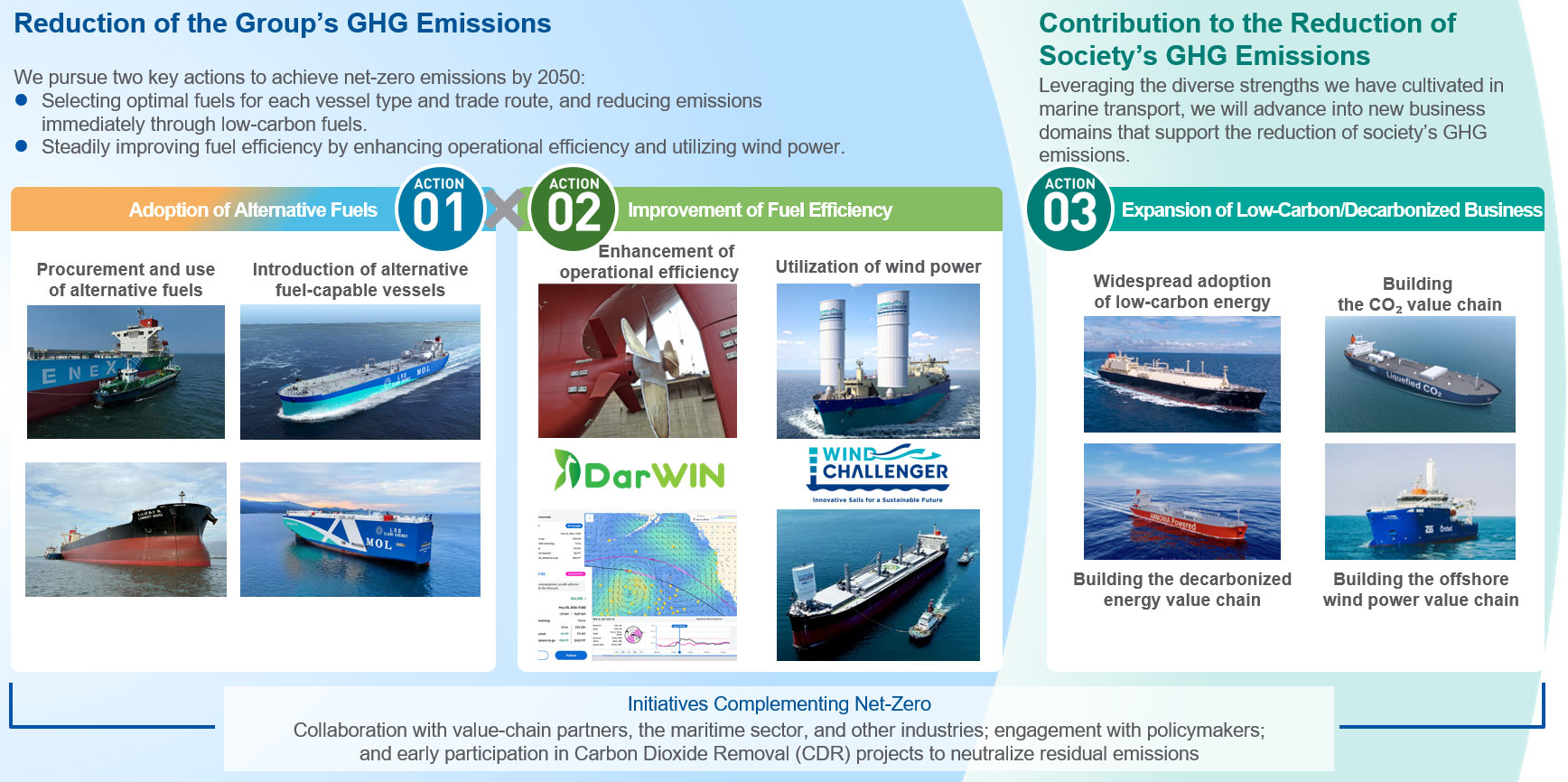
Overview of Action Plans
Milestones
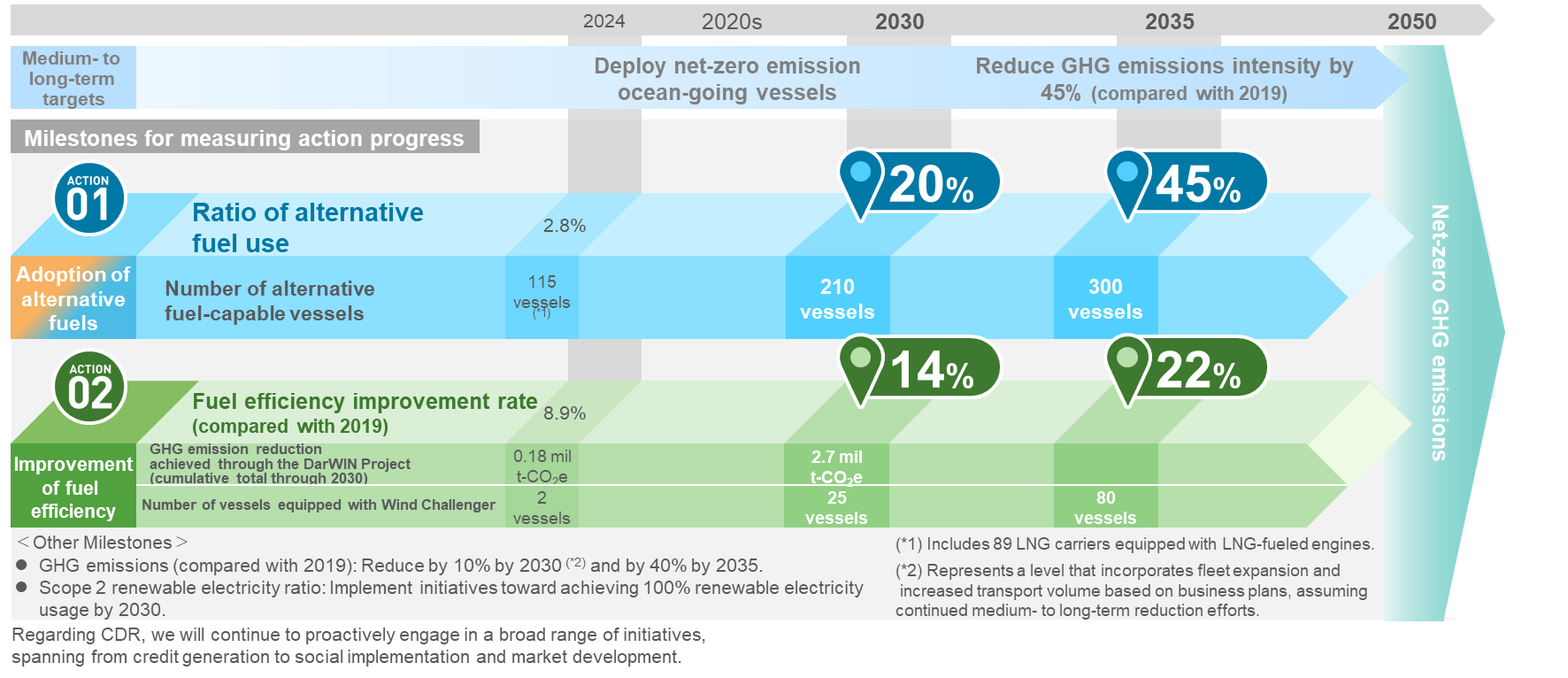
To ensure the achievement of net-zero emissions, we have set quantitative KPIs and milestones for measuring progress for each action.
Progress
We are making steady progress toward achieving each goal and milestone set forth in the "MOL Group Environmental Vision".
Progress toward medium- to long-term targets
| Medium- to long-term targets | FY2025 Results | ||
|---|---|---|---|
| In the 2020s | Net zero emissions ocean-going vessels | Deploy | 0 vessels |
| 2035 | GHG emissions intensity | ▲45% (compared to 2019) |
▲12.1% |
| 2050 | GHG emissions All of scope 1,2,3 |
▲90% or more (compared to 2019) |
Scope1+2: ▲15.6%(*1) |
(*1) If residual emissions remain in the net zero target year(2050), we will neutralize them with Carbon Dioxide Removal(CDR).
Progress on Milestones
| Division | Indicators | Milestones | |||
|---|---|---|---|---|---|
| FY2025 Results | FY2030 | FY2035 | |||
| Adoption of alternative fuels - ACTION 01 |
Ratio of alternative fuel use | 4.4% | 20% | 45% | |
| Fossil LNG | 3.3% | - | - | ||
| Bio-LNG | 0.1% | - | - | ||
| Biodiesel | 1.0% | - | - | ||
| Number of alternative fuel-capable vessels | 125 vessels | 210 vessels | 300 vessels | ||
| LNG-DF Vessels (LNG carriers) | 87 vessels | - | - | ||
| LNG-DF Vessels (excluding LNG carriers) | 25 vessels | - | - | ||
| Methanol-DF vessels | 6 vessels | - | - | ||
| LPG-DF vessels | 7 vessels | - | - | ||
| Improvement of fuel efficiency - ACTION 02 |
Improvement of fuel efficiency % (compared with 2019) |
10.7% | 14% | 22% | |
| GHG emission reduction achieved through the DarWIN Project (cumulative total through 2030) |
0.52 mil t-CO2e | 2.7 mil t-CO2e | - | ||
| Number of vessels equipped with Wind Challenger | 3 vessels | 25 vessels | 80 vessels | ||
| Vision Overall | GHG emissions Scope1,2, and part of scope 3(*2) (compared with 2019) |
▲14.3% | ▲10% | ▲40% | |
| Ratio of power from renewable energy for Scope 2 | 65.7% | 100% | - | ||
(*2) This refers to emissions at the fuel production stage of marine fuels used by the Group’s operated oceangoing vessels, which fall under Category 3 (fuel- and energy-related activities not included in Scope 1 or Scope 2).
Initiatives related to Carbon Dioxide Removal (CDR)
To ensure achieving the neutralization of remaining emissions anticipated in the future and to promote the spread and expansion of negative emissions in order to achieve decarbonization throughout society, we are advancing both nature-based and technology-based initiatives from the early stage. Specific examples are shown below.
[Nature-based solutions]
We are engaged in nature-based solutions centered on forests and mangroves, including participation in mangrove restoration and conservation projects in Indonesia. We also invest in funds focused on forest restoration and conservation in Latin America. Through these efforts, we aim not only to remove CO2 but also to contribute to biodiversity and support local communities.
[Technology-based solutions]
We participate in the NextGen CDR Facility, which creates long-term demand through collective purchasing of carbon removal credits from technology-based CDR. We further contribute to demand creation through offtake agreements and project involvement with global companies such as Climeworks (DAC), Alt Carbon (ERW), and Captura and Vycarb (Marine CDR), thereby supporting the early deployment and market development of advanced CDR technologies.
We will give due consideration to the integrity of the CDR credits we procure by selecting credits that have been certified by third-party organizations, as well as by referring to external evaluations and individually verifying them ourselves by referring to relevant guidelines.
Previous Environmental Visions
- Sustainability TOP
- Message from the Chief Sustainability Officer
- Sustainability
Management - Value Creation
Stories - Environment
- Safety
- Human Capital
- Digital Transformation
- Governance
- Social Contribution
Activities - Stakeholder
Engagement - Sustainable Finance
- Sustainability Data
- ESG Disclosure
Guideline Indexes - External Recognition
- Library