
- JP
- EN
Sustainability Management
- Basic Policy to Sustainability Management
- Sustainability Management System
- Sustainability Issues (Materiality)
- MOL Sustainability Plan
Basic Policy to Sustainability Management
The MOL Group's sustainability management is based on a long-term strategy that aims to achieve sustainable growth in our group together with society.
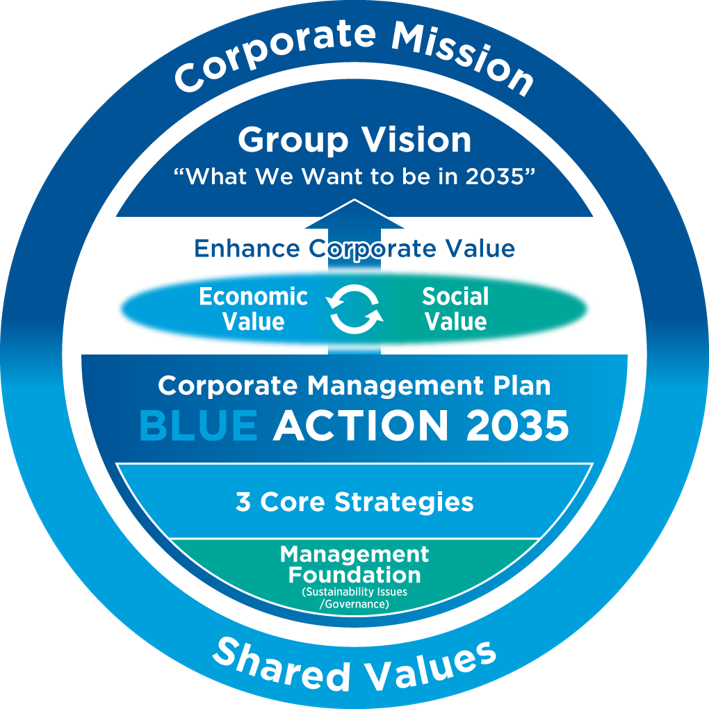
In the Group Vision for 2035, we state our intent to "take a leap toward becoming a global social infrastructure company," and we engage in the "BLUE ACTION 2035" group management plan to realize this vision.In the Group Vision for 2035, we state our intent to "take a leap toward becoming a global social infrastructure company," and we engage in the "BLUE ACTION 2035" group management plan to realize this vision. We will pursue "BLUE ACTION 2035" in line with the spirit of the MOL Group Corporate Mission and its values, "MOL CHARTS," and maximize the value we provide to all stakeholders by creating both economic and social value. The economic value generated by the MOL Group is primarily measured and managed through the financial Core KPIs defined in "BLUE ACTION 2035." Social value is categorized into three areas: "provision of infrastructure that supports daily life and industry," "realization of a sustainable ocean and global environment," and "enhancement of well-being."
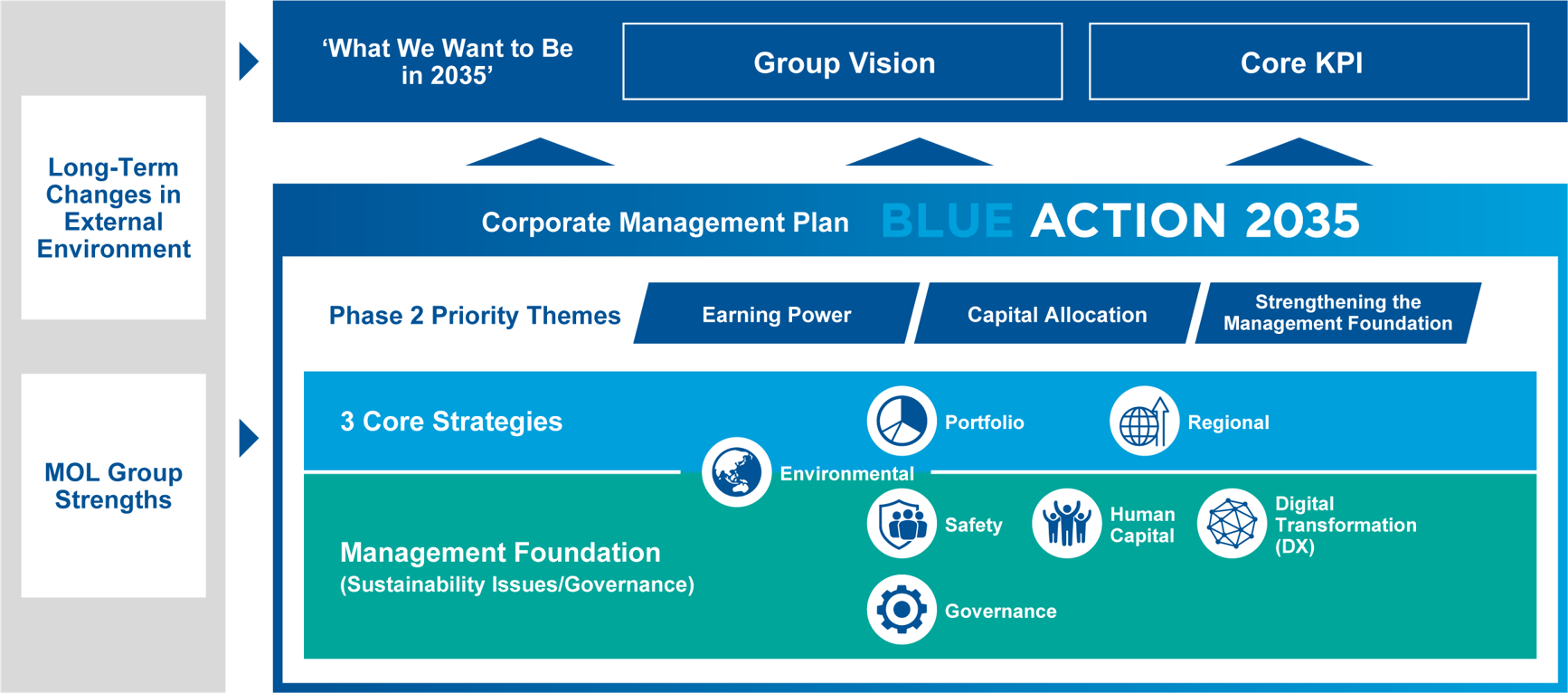
Under "BLUE ACTION 2035" Phase2, which began in fiscal 2026, in addition to our 3 core strategies (Portfolio, regional and environment), we will focus on the Sustainability Issues (materiality) of the environment, safety, human resources, and DX as the management foundation to support these strategies, as well as a permanent corporate theme of governance.
- The Framework of BLUE ACTION 2035
- The Blueprint of BLUE ACTION 2035
Sustainability Management System
The MOL Group has established a management system with the President & CEO responsible for pursuing sustainability management on a group-wide scale. Key sustainability management issues are mainly discussed by specific committees (Sustainability Committee, BLUE ACTION Committee, Investment Strategy Committee, Safety & Quality Enhancement Committee, HC Action Committee, and Compliance Committee), which are subordinate to the Executive Committee. The Board of Directors oversees all sustainability-related initiatives. Particularly important policies, strategies, and other matters are decided after deliberation by the Executive Committee and each committee, followed by a resolution by the Board of Directors.

Sustainability Committee
This is a cross-functional organization that meets about once a month to deliberate on the group's sustainability strategy (identification and review of materiality, formulation of sustainability plans, confirmation of progress, and so on) and other initiatives such as the environment, human rights, value chain management, and social contribution activities.
- Sustainability Committee Key Agenda Items for FY2025
-
- Revision of Environmental Vision, Safety Vision, Human Capital Vision, and DX Vision
- Review of environmental strategies based on the IMO Net-Zero Framework
- Disclosure based on TNFD
- Social Contribution Activities
Sustainability Discussions
Apart from general resolutions and reports, the Board of Directors will also discuss sustainability. This is intended to strengthen the board's involvement in reviewing sustainability management policies and strategies. In FY2025, we discussed how social value should be reflected in management. Other matters are discussed regularly by the Sustainability Committee and are reported to and deliberated by the Board of Directors and the Management Committee as appropriate.
Advisory Board
We believe it is important to respond appropriately to changes in global situations, social values, and technology, and to strategically optimize the balance of our business portfolio. Therefore, we have established an Advisory Board consisting of outside experts under the President & CEO, with the objective of obtaining opinions on prioritized areas from the perspective of updating and enhancing our management strategies and risk management.
Sustainability Issues (Materiality)
Our group has identified key issues as "sustainability issues" (materiality) in order to achieve sustainable development together with society by realizing the Group Vision.
Since first identifying the Sustainability Issues in fiscal year 2019, we have conducted periodic reviews taking into account changes in both the external and internal environment. From fiscal year 2026, we have reorganized these into the following four material issues. The revision in fiscal year 2026 was carried out in parallel with the formulation of Phase 2 of the management plan "BLUE ACTION 2035." In order to clearly demonstrate the areas on which the MOL Group will focus, we identified issues that contribute to the creation of both economic and social value as our core material issues. For each of the four issues, we have established targets, KPIs, and action plans, and we manage progress toward their resolution.
The content of these sustainability issues was approved by the Board of Directors in March 2026. The Board also oversees the status of related initiatives, and we will continue to annually assess the need to review our materiality and make revisions as necessary in response to changes in the business environment.
| Materiality | Priority themes | Main targets and KPIs | Action | SDGs to which we contribute |
|---|---|---|---|---|
 |
Climate Change Marine Environment |
|
Refer to "Environmental Vision" |  |
 |
Human Life Marine Environment Stable Operations |
|
Refer to "Safety Vision" | 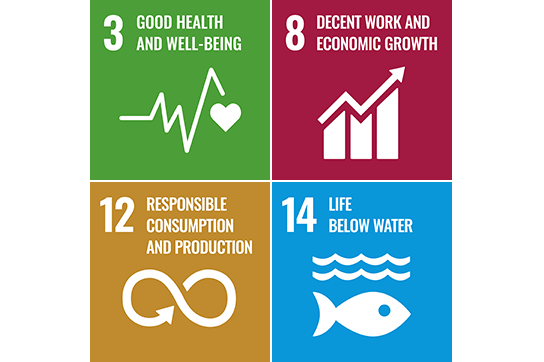 |
 |
Diversity, Equity & Inclusion Mutually Empowered Highly Engaged |
|
Refer to "Human Capital Vision" | 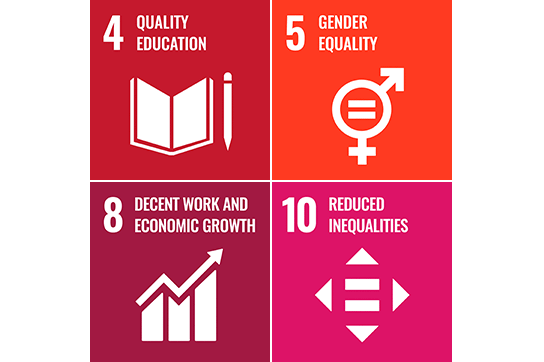 |
 |
IT/Digital Infrastructure Productivity & Safety Business Transformation |
|
Refer to "DX Vision" | 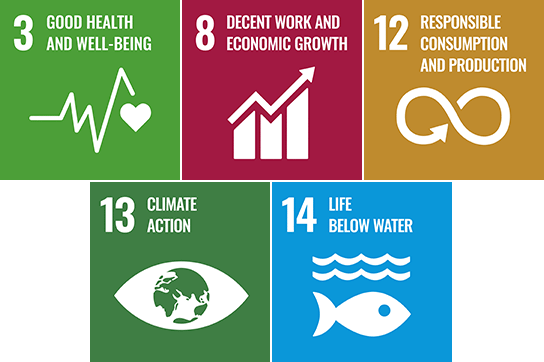 |
Identification process
In line with Phase2 of BLUE ACTION 2035, a management plan launched in 2026, we reviewed the material issues in the following steps.
- STEP1Identification of materiality candidate themes
-
Based on the European Sustainability Reporting Standard (ESRS) and referring to other international guidelines for disclosure of sustainability information, we identified candidate themes for materiality.
< Guidelines used for reference >
- European Sustainability Reporting Standard (ESRS)
- SASB Standard
- SDGs
- Stakeholder Capitalism Metrics
- STEP2Double materiality assessment
- Adopting the concept of double materiality, we conducted an assessment of impacts, risks, and opportunities related to the materiality candidate themes identified in STEP1.
Impact, risks and opportunities were assessed using the assessment methods defined in the European Sustainability Reporting Standards (ESRS). Impact was calculated by multiplying the severity (Size, scope, and difficulty of recovery) by the likelihood of occurrence, and risk and opportunity was calculated by multiplying the size of the potential financial impact by the likelihood of occurrence. - STEP3Evaluation from stakeholder and our company perspectives
-
Candidate themes for impacts, risks and opportunities that exceeded the threshold in STEP2 were prioritized in terms of their importance to stakeholders and the Company.
Regarding the stakeholder axis, we evaluated its importance by referring to records of engagement with investors, shareholders, customers, business partners, employees, and NPOs and NGOs. We also conducted separate interviews and questionnaires with investors and shareholders.
The importance of the corporate axis was evaluated from the perspective that it is highly related to the corporate philosophy and group vision, social value created, business strategy, and our group's strengths.
We also confirm the validity of the assessment with members of the Advisory Board.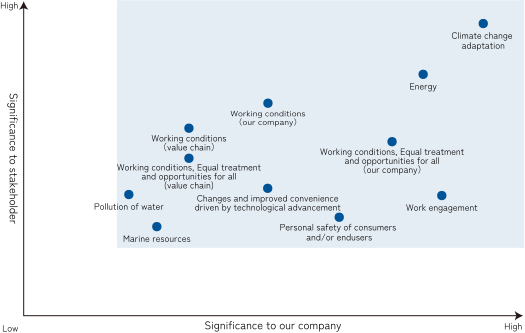
- STEP4Reconfigure materiality (organize themes)
-
In STEP3, we organized the themes that exceeded the threshold in terms of both stakeholders and our own company, and organized them into four issues: the environment, safety, human resources, and DX.
The table below shows our recognition of impacts, risks and opportunities for each issue.Materiality Priority themes Impact/Risk/Opportunity Details of impact/risk/opportunity Materialization timing*1 Related business*2 Related of ESRS topics Environment Climate Change Impact (negative) 1 Acceleration of climate change due to high GHG emissions from the combustion of marine fuels Short- to long-term Shipping E1 Climate change adaptation, Energy Risk 2 Increase in expenditures due to capital investments required to comply with environmental regulations Short and medium term Shipping Risk 3 Increase in expenditures resulting from penalties, taxation, and reputational damage caused by violations of environmental regulations Short and medium term Shipping Risk 4 Deterioration of revenues due to declining demand for high-GHG-emitting resources such as fossil fuels as decarbonization progresses Short- to long-term Shipping Opportunity 5 Strengthening of competitiveness through the introduction of low- and zero-carbon technologies, leading to increased revenues Short and medium term Shipping、Energy infrastructure Opportunity 6 Increase in revenues through business development that anticipates demand for low- and zero-carbon technologies and fuels, including the wider adoption of clean energy Medium and long term Shipping、Energy infrastructure Opportunity 7 Reduction in expenditures through improved fuel efficiency, such as the introduction of energy-saving equipment and optimized vessel operations Short and medium term Shipping Marine Environment Impact (negative) 8 Potential adverse impacts on marine ecosystems and coastal fisheries and tourism industries in the event of fuel or cargo spills caused by groundings or collisions Short- to long-term Shipping、Energy infrastructure E2 Pollution of water
E3 Marine resourcesRisk 9 Increase in expenditures resulting from penalties and reputational damage due to environmental regulation violations triggered by oil spills and similar incidents Short term Shipping、Energy infrastructure Safety Human Life Impact (negative) 10 Damage to the life and health of employees and business partners across the value chain Short term Shipping、Energy infrastructure、Ports and logistics、Cruise and ferry S1 Working conditions
S2 Working conditionsRisk 11 Increase in expenditures due to penalties, litigation, and reputational damage arising from harm to the life and health of employees and business partners Short term Shipping、Energy infrastructure、Ports and logistics、Cruise and ferry Risk 12 Increase in expenditures due to employee turnover resulting from inadequate workplace safety, as well as medical expenses and related costs Short term Shipping、Energy infrastructure、Ports and logistics、Cruise and ferry Marine Environment Impact (negative) 13 Refer to 9 Same as left Same as left Same as left Risk 14 Refer to 10 Same as left Same as left Stable Operations Risk 15 Increase in expenditures due to fines, litigation, and reputational damage resulting from major accidents Short term Shipping、Cruise and ferry S4 Personal safety of consumers and/or endusers Opportunity 16 Strengthening of competitiveness through the continuous maintenance and enhancement of safety and quality, as well as ensuring the safety of newly introduced technologies, including low- and zero-carbon technologies, leading to increased revenues Short- to long-term Shipping Human Capital Diversity, Equity & Inclusion Opportunity 17 Improved productivity through the recruitment of diverse talent and expansion of business opportunities by leveraging diverse perspectives, resulting in increased revenues Short- to long-term Shipping、Energy infrastructure、Ports and logistics、Cruise and ferry、Real estate、Related businesses and others S1 Working conditions, Equal treatment and opportunities for all S2 Working conditions, Equal treatment and opportunities for all Mutually Empowered Opportunity 18 Create innovation and expand business opportunities by leveraging synergies through collaboration across organizational boundaries, thereby increasing revenues Short and medium term Shipping、Energy infrastructure、Ports and logistics、Cruise and ferry、Real estate、Related businesses and others Highly Engaged Opportunity 19 Improved productivity and employee retention through enhanced job satisfaction, resulting in reduced expenditures and increased revenues Short and medium term Shipping、Energy infrastructure、Ports and logistics、Cruise and ferry、Real estate、Related businesses and others Digital Transformation IT/Digital Infrastructure Productivity & Safety Business Transformation Opportunity 20 Deepening operational efficiency through the introduction of advanced technologies, contributing to climate change mitigation Short- to long-term Shipping E1 Climate change adaptation, Energy Opportunity 21 Enhance operational efficiency and safety through technological advancements, enable faster and more informed management decision-making, and thereby increase revenues. Short- to long-term Shipping、Energy infrastructure、Ports and logistics、Cruise and ferry、Real estate、Related businesses and others SPorts and logisticsking conditions S2 Working conditions S4 Personal safety of consumers and/or endusers - *1 Starting from 2025, the short-term is within 1 year, the medium-term is within 5 years, and the long-term is over 5 years.
- *2 Our group's businesses include "shipping," "energy infrastructure," "ports and logistics," "cruise and ferry," "real estate," and "related businesses and others" for analysis.
MOL Sustainability Plan
Prior to fiscal 2025, the MOL Sustainability Plan was used to manage the progress of materiality-related targets, KPIs, and action plans. Since fiscal 2026, we have been implementing progress management in accordance with our Environmental Vision, Safety Vision, Human Capital Vision, and DX Vision.
- Sustainability TOP
- Message from the Chief Sustainability Officer
- Sustainability
Management - Value Creation
Stories - Environment
- Safety
- Human Capital
- Digital Transformation
- Governance
- Social Contribution
Activities - Stakeholder
Engagement - Sustainable Finance
- Sustainability Data
- ESG Disclosure
Guideline Indexes - External Recognition
- Library